SAP Joule vs. Your Stack: Coexist, Don't Rip-and-Replace
Joule isn't your enemy - unplanned duplication of agents, data, and governance is. The coexistence strategy that actually works, and the 2x2 decision matrix that saves you from duplicate agents.
The SAP account executive smiled. "Joule is the AI copilot for your entire estate." The CIO nodded. The architect, a woman named Priya who'd built the custom ServiceNow-SAP incident bridge three years ago, kept her laptop closed.
Six months later, the organization had two agents creating sales orders. Joule did it through the SAP S/4HANA public API. The custom agent did it through a Z-function module wrapped in a REST endpoint the integration team built in 2019. Both worked. Both were in production. Neither team knew the other existed until month-end close showed a 12% variance in order counts.
This is not a Joule problem. This is a governance problem that Joule exposed. SAP's pitch is clear: Joule is the AI layer for SAP. Your custom agents, your ServiceNow virtual agent, your Salesforce Einstein bot, your homegrown Slack bot - they all do things Joule now does. The vendor's implicit ask: retire the custom stuff, adopt Joule. The reality: you have 15 years of business logic encoded in custom agents that Joule doesn't know about, running on infrastructure Joule doesn't touch, governed by policies Joule doesn't enforce. Rip-and-replace is fantasy. Coexistence is the only strategy that ships.
Coexistence playbook
- Single source of truth - finance numbers come from one path, cited in both UIs
- Role boundaries - Joule for clerks in SAP; your agents for architects and ops
- Shared governance - same data classification, same logging standards
- Clean core alignment - extensions via APIs, not shadow bots scraping screens
You don't need a migration. You need a capability registry with ownership assigned. Every capability in your landscape - "create sales order," "check AR balance," "summarize incident," "draft purchase req" - gets placed in a 2x2: Joule owns, custom owns, kill duplicate, or dual-source with contract.
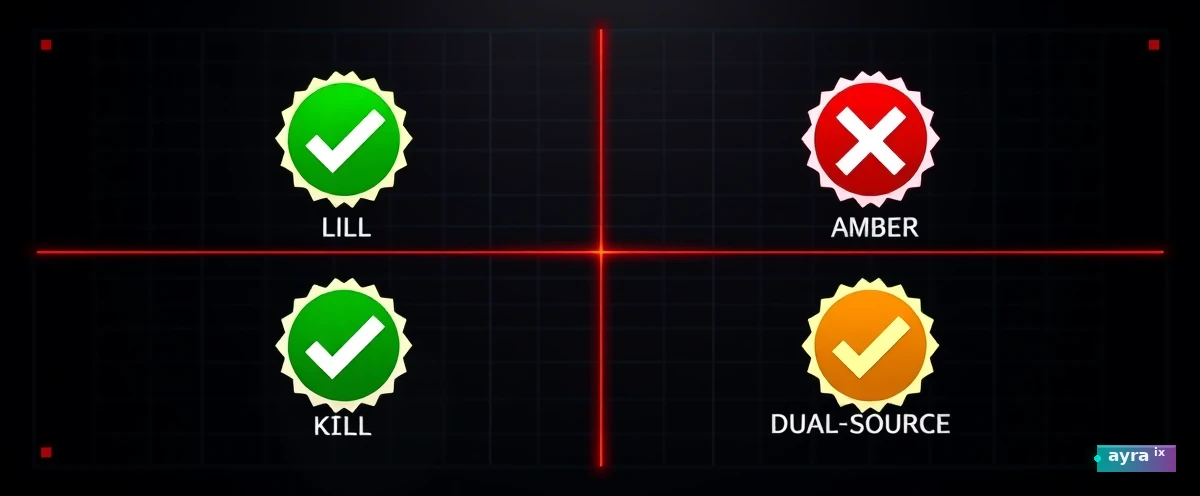
| Quadrant | Owner | Action |
|---|---|---|
| Joule does it better | Joule | Retire custom agent |
| Custom does it better | Custom | Keep, document API contract |
| Both do it | Joule (standard) | Retire custom, redirect calls |
| Neither does it well | Both | Contract: which is source of truth? |
The matrix forces the conversation Joule's arrival should have triggered on day one: who owns what?
Clean core was the price of AI-ready ERP. Joule is SAP's collect call - pay with architecture discipline, not duplicate brains.
Data lineage when two brains answer
Joule reads SAP tables your custom agent also queries - through different paths, with different caching, on different refresh cycles. Users will compare answers and assume one system is lying.
The duplication isn't just agents. It's data. Joule reads the SAP FICO table BKPF with a 5-minute cache. Your custom stack reads the warehouse WMS + SAP + Ariba in real-time. The CFO asks "what's our AR balance?" Joule says $2.4M. Your custom agent says $2.38M. The $20K variance triggers an audit. Nobody owns the reconciliation because governance never assigned it.
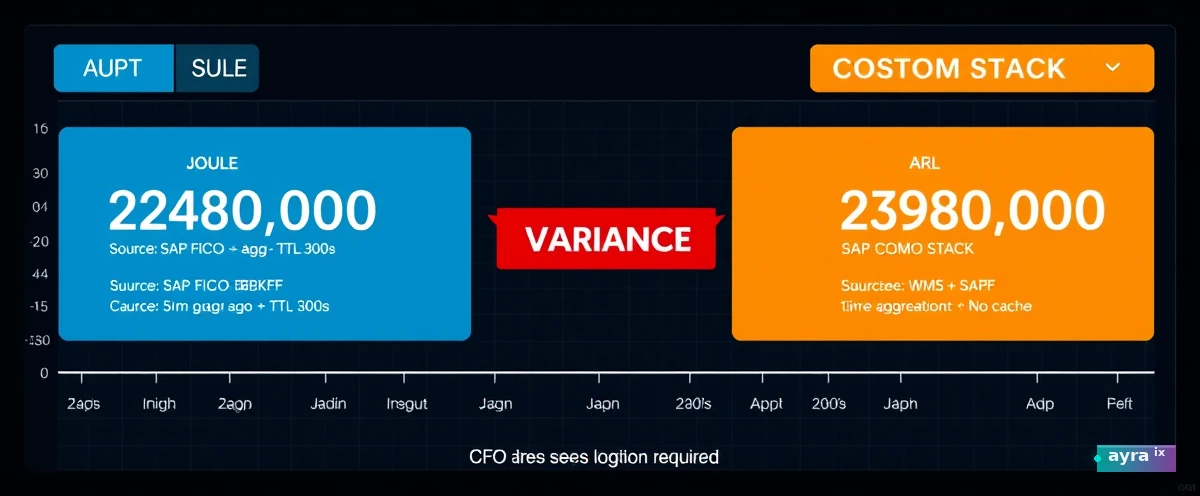
Define lineage: which system is authoritative for which metric, and display citations in both UIs. Split by domain: Joule owns in-transaction help; your stack owns cross-system analytics and proprietary policy RAG. Document the split in architecture decision records, not hallway agreements.
- API-first extensions - clean core means Joule and your agents share APIs, not screen scrapes
- Identity mapping - same user, same roles, consistent entitlements across UIs
- Audit harmonization - one log taxonomy for AI actions, SAP-native or not
- Upgrade calendar - Joule updates on SAP's schedule; plan regression windows
Two agents without a source-of-truth map is two helpdesks arguing in front of the CFO.
When to let Joule win
Don't rebuild what SAP embeds well - transactional wizards, field help, role-aware Fiori actions. Your budget is better spent on warehouse-plus-SAP incident flows, custom compliance corpora, and integrations Joule will never prioritize. Pride kills more architectures than Joule does.
Inventory your AI use cases on a 2x2 - SAP-native vs. cross-system, read vs. write. Joule takes the SAP-native quadrant; you take cross-system. Anything in the overlap gets killed or explicitly dual-sourced with citations.
| Use case | Owner |
|---|---|
| Fiori field assist | Joule |
| ServiceNow + SAP bridge | Your stack |
| Custom policy RAG | Your stack |
| Duplicate AR queries | Pick one source |
Licensing and footprint
Joule rides your SAP license and footprint - custom stacks ride headcount and integration debt. Total cost comparisons must include both. Sometimes Joule is cheaper for SAP-native scope even if less flexible; sometimes custom wins on cross-system jobs. Do the math per use case, not once globally.
Architecture review board scores each AI initiative on fit - Joule, custom, or hybrid - before build starts. Prevents duplicate spend and turf wars between platform teams.
Change management for dual UIs
Users will ask which assistant to trust. Training and in-app guidance beat architecture diagrams. Document "use Joule here, use portal here" in workflows, not wiki pages nobody reads. Product owners own the split per journey - order-to-cash, hire-to-retire - not a central AI team guessing in a vacuum.
Regression on SAP upgrades
Every SAP upgrade season, retest Joule and custom agents on the same ten questions. Answer drift after patches is normal; undocumented drift is an incident waiting for month-end close. The three contracts make this concrete: API contract with version and SLA, data contract with source-of-truth ownership, governance contract with one change advisory board.
Without these contracts, coexistence is just chaos with a better story.
Joule plus your stack works when each has a territory map - not when both answer everything.
Draw the territory map before Joule does it for you
The 2x2 in this piece - SAP-native vs. cross-system, read vs. write - isn't a thought exercise, it's a document with named owners due before the next SAP release. If you haven't assigned every current AI use case to Joule, your stack, or "kill it," SAP's rollout schedule will make that decision for you, and it won't ask which system your CFO already trusts for AR numbers.
Don't let the Joule admin and the custom agent admin operate in separate orgs with separate budgets and separate roadmaps. That's how you get two "create sales order" agents, two AR balances, and a CFO who stops trusting both. Assign a single product owner for "SAP AI Capabilities." Their KPI: zero duplicate capabilities. Their budget: unified. Their roadmap: the 2x2 matrix, updated quarterly.
Priya opened her laptop six months later. The 2x2 matrix was on the wall. The Z-function for "create sales order" had a deprecation date. The ServiceNow bridge had an API contract with an owner and an SLA. The AR balance variance was zero. The CFO never asked about Joule again. Coexistence isn't compromise. It's the only architecture that ships.
Quick check — did this stick?
Question 1 of 3Keep exploring on ayraix.com
Stay with us · explain
What is your organization's approach to integrating new AI tools like SAP Joule with existing systems?
Do you lean towards a coexistence strategy or are considering a full replacement of legacy solutions?
No account needed — pick a take, then keep reading. We rotate these prompts so each piece feels like a conversation, not a clone.