Small Models at the Edge: When 3B Beats 70B
Not every inference needs a datacenter brain. Small models on device win on latency, privacy, and bills — if you scope them right.
Everyone wants the biggest model that fits. Meanwhile the warehouse scanner needs to classify damage types in 200ms offline, and the factory can't send photos to a cloud API. Small models at the edge are not diet cloud — they're a different product category.
Here's the thing: 3B models excel at classification, extraction, routing, and constrained generation with tight schemas. They fail at open-ended reasoning and rare long-tail knowledge. Edge wins when the task is narrow, latency-sensitive, privacy-bound, or connectivity-poor.
Design for small
Shrink the output space — enums, JSON schemas, picklists. Distill from teacher models on your labels. Test on real devices, not developer laptops with unlimited RAM.
Edge AI's enemy isn't model size — it's scope creep. One job per deployment.
Hardware reality on the edge
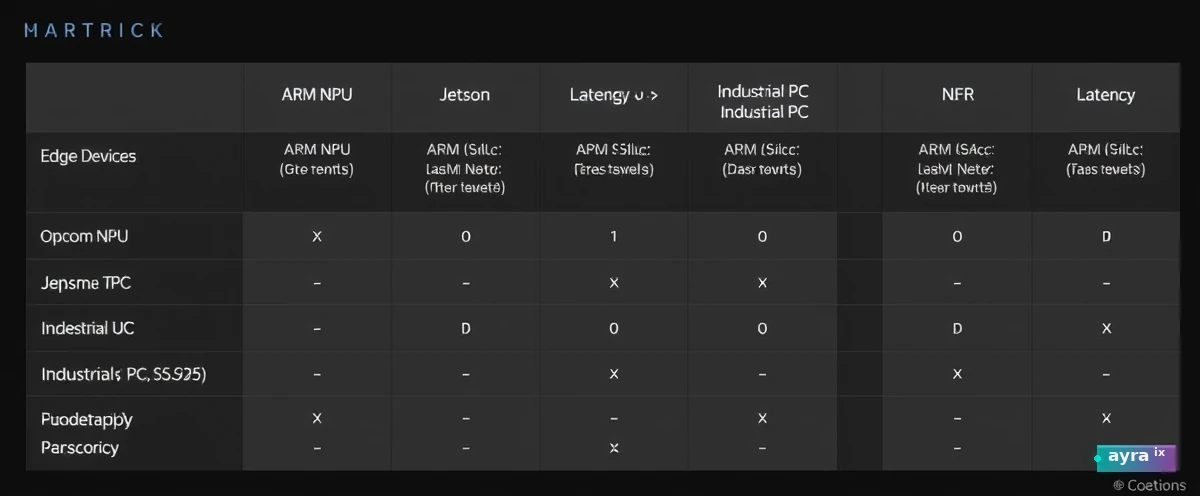
Developer laptops lie. Edge devices have thermal throttling, shared RAM with cameras, and batteries that hate sustained inference. Profile on the actual SoC — ARM NPU, Jetson, industrial PC — not your M3 Max. Latency budgets that work in the lab die in the warehouse at noon in July.

Quantize aggressively for edge, but validate accuracy on real labels after quant — not on MMLU. A 3B Q4 that misclassifies dent types is worthless at 300ms. Sometimes Q8 or a slightly bigger model is the correct ops call.
- OTA updates — signed model bundles; rollback when field accuracy drops
- Offline-first UX — queue and sync; don't spin forever waiting for cloud
- Sensor fusion — combine camera with weight scales, barcodes, RFID when possible
- Field logging — capture misclassifications for retrain — with privacy filters
Edge AI fails in the field, not in the notebook — test where the forklifts are.
Teacher-student pipelines that work
Use a large cloud model to label edge cases, then distill to small on-device. Human review the disagreements — that's your highest-value training set. Iterate monthly; edge models age when product SKUs change.

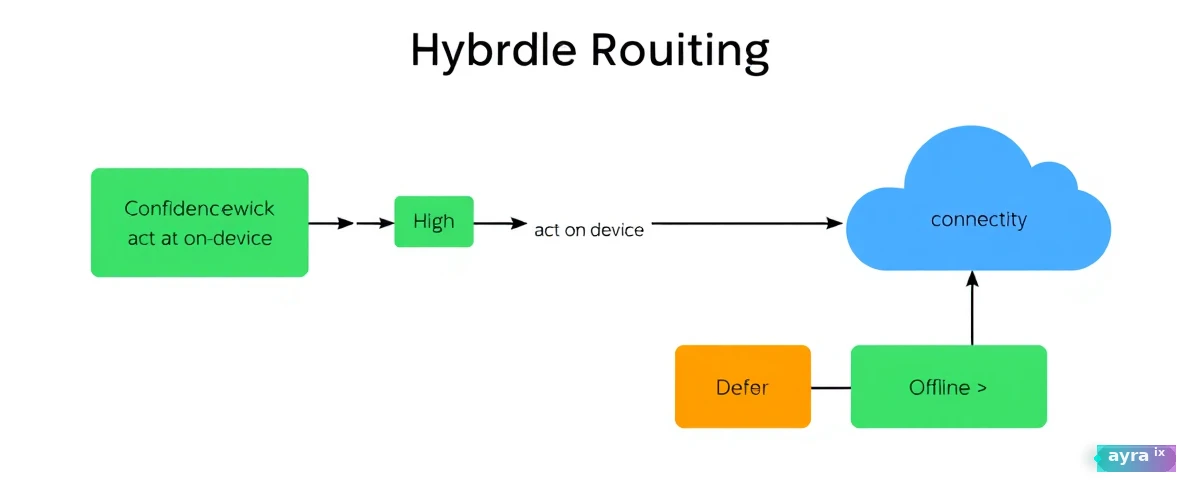
Hybrid route low-confidence edge predictions to cloud — same waterfall thinking as datacenter routing, different power budget. One job per deployment; scope creep kills edge projects faster than wrong model size.
| Condition | Action |
|---|---|
| Confidence > threshold | Act on-device |
| Low confidence | Queue for cloud |
| Connectivity lost | Defer or human flag |
Security on the edge
Edge devices get stolen, reflashed, and probed. Sign models, encrypt weights at rest, rotate keys. A small model on a camera in a secure facility is still an attack surface — treat firmware and model bundles like secrets.
Threat-model physical access separately from cloud. Edge wins on privacy only if exfiltration from device is hard. Mortal red teaming applies here too.
Monitoring without cloud
Edge can't phone home for every metric. Batch telemetry when connected; local counters for latency and error rate when not. Design dashboards that tolerate offline gaps without blind spots.
Edge devices report health summaries, not raw inference logs — bandwidth and privacy both win.
Labeling economics
Edge models need field labels — budget for ops time, not just ML time. Teacher labels without human audit drift on long tail classes.
Monthly label review on edge misclassifications. Small models rot when SKUs change faster than retrain cycles.
Power budgets in the field
Battery devices need wake-word or button-triggered inference — always-on vision drains shifts. Scope inference to seconds per event, not continuous streaming, unless plugged in.
Edge wins when the job is narrow and the environment is hostile — bad connectivity, privacy, latency. Scope creep turns edge projects into miniature cloud bills with worse tooling.
Document minimum firmware and driver versions per edge SKU. Field variance kills models that looked perfect on the bench — pin the stack like you pin the weights. Publish a one-page hardware matrix before pilots leave the lab. Update it when firmware drifts.
Hybrid architectures route edge classification to cloud only on low confidence — same waterfall thinking as The Waterfall Router Pattern.
Pick the one job before you pick the model size
Every failure mode in this piece — thermal throttling, misclassified dents after quantization, edge devices going stale between SKU changes — traces back to the same root cause: someone tried to make a 3B model do more than one job. Scope the deployment first (classification, extraction, or routing — pick one) and only then size the model against real hardware, not a developer laptop.
A 3B model that nails one narrow, hostile-environment job beats a 70B model you can't run offline. Edge AI's ROI comes from scope discipline, not parameter count — protect that discipline harder than you protect the weights.
Edge AI's enemy isn't model size — it's scope creep. One job per deployment.
Your move: This week, identify one inference task in your pipeline that does not need a 70B+ model — classification, extraction, formatting. Scope it to a 3B model and run it locally. Measure latency, accuracy, and cost against your current approach. The gap will be smaller than you expect, and the operational simplicity will be larger.
Stay with us · challenge
Which task do you think is best suited for edge AI?
Given the constraints and advantages of edge AI, which of these tasks would benefit most from being handled on-device rather than in the cloud?
No account needed — pick a take, then keep reading. We rotate these prompts so each piece feels like a conversation, not a clone.