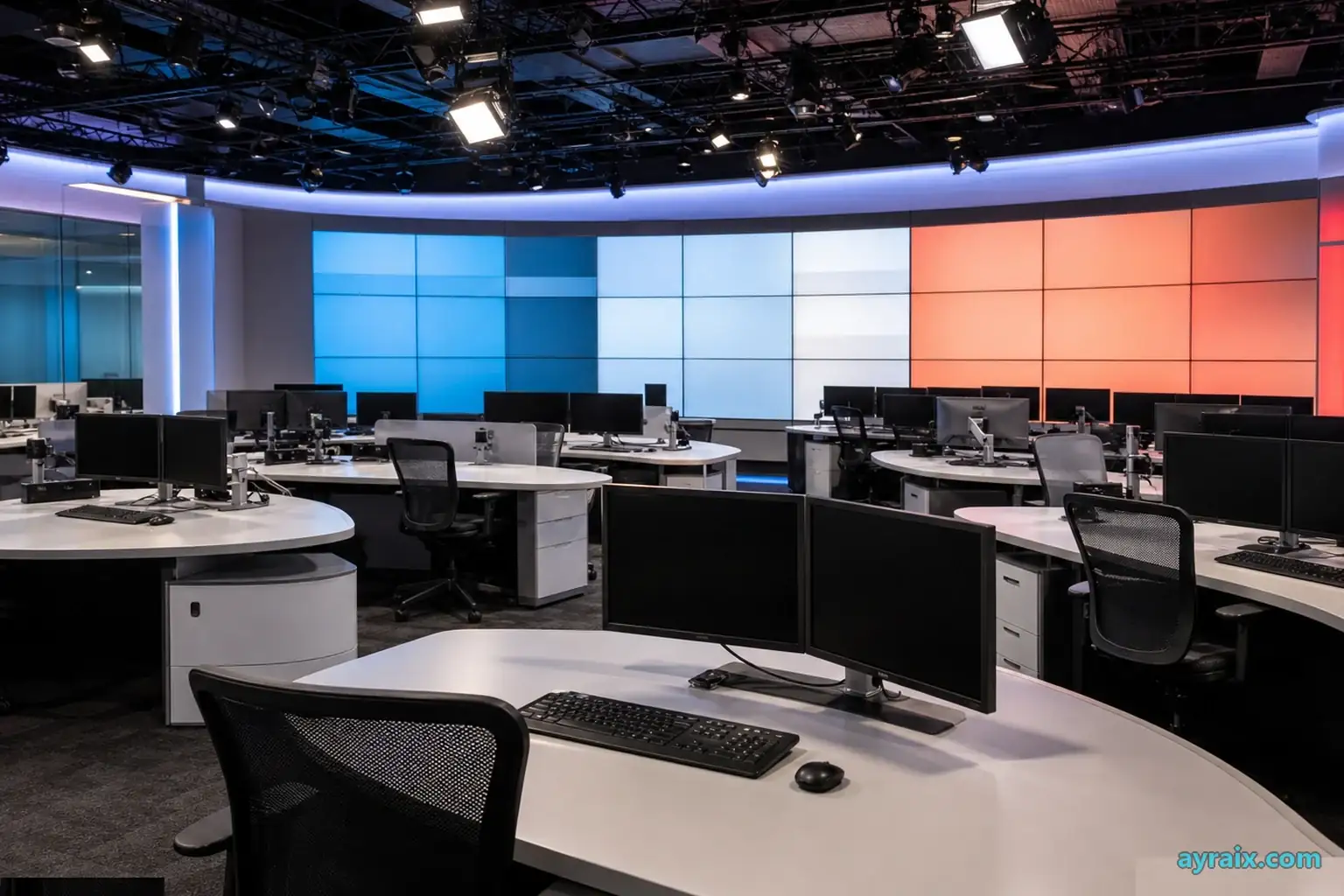
Composite — newsroom war room, election week. A clip lands in Slack with three fire emojis. Someone says “looks real.” Someone else says “run it through the detector.” Both know the detector will print a confidence score that calms the room without settling the truth. Late July 2026 midterm media rooms are drowning in pledges: watermarking, labeling, “we will not deploy deceptive AI.” The volume of promises is not the same as trust infrastructure. Campaigns can still ship rapid synthetic creatives, micro-targeted cuts, and ambiguous “parody”-adjacent spots while the pledge PDF sits on a website. Call this verification theater: accountability language without rails voters, platforms, and regulators can actually enforce.
The gap between verification theater and actual trust infrastructure is the defining media integrity story of this election cycle. Campaigns have discovered that a verification pledge sounds like accountability without requiring any accountability. The infrastructure that would actually prevent a synthetic clip from moving a stock price or swinging a district — independent provenance tracking, real-time detection at platform scale, legal consequences for non-disclosure — does not exist at enforceable scale. What exists is a patchwork of voluntary commitments, soft guidelines, and platform policies written by teams already overwhelmed by the volume of synthetic content they are supposed to police.
Composite Case: The 47-Minute Clip
Composite case — not a named incident. At 9:12 a.m., a ninety-second audio file appears to show a Senate candidate describing a closed-door deal with a regional hospital chain. By 9:18 it is clipped, captioned, and running in three district WhatsApp groups. By 9:40 a local radio host is “just asking questions.” By 10:00 the campaign’s rapid-response account posts a denial and a link to its AI ethics pledge. By 10:15 a detector tool returns “likely synthetic — moderate confidence.” By 10:47 a political betting market and a thin biotech name have already moved on the rumor of a pricing stance that was never said. Nobody needed the clip to be true. They needed the clip to be faster than verification.
That forty-seven-minute window is the product. Verification theater measures itself in press releases and labeled hero ads. Harm measures itself in the minutes between upload and irreversible reaction — votes, donations, trades, reputation. A pledge that covers the television spot does not cover the group-chat mutant. A confidence score that arrives after the market move is not infrastructure. It is a receipt.
The Verification Theater
Verification theater follows a predictable pattern. A campaign announces a partnership with a digital credentials provider. It publishes a policy on synthetic media disclosure. It releases a few ads with "AI-generated" labels in fine print. The press covers the announcement as a sign of responsible campaigning. Then the field operation — or a cutout, or a “supporter” page the campaign can disavow — deploys a swarm of micro-targeted synthetic audio and video variants: testimonials, endorsements, attack cuts personalized to specific demographics in specific districts. Many variants carry no disclosure. Many sit outside the credentialing partnership. Many are not caught by the tools the campaign itself pledged to use, because the tools were never scoped for volume.

The structure of modern campaign media makes this almost inevitable. A campaign that once lived on a handful of television spots can now ship an order-of-magnitude more synthetic variants — tailored audiences, rapid A/B tests, distribution paths that blur paid political ads and organic-looking posts. Treat any exact “10 vs 1,000” ratio as illustrative scale, not a measured industry census. The point holds without fake precision: pledges cover the visible hero creatives; the swarm lives underneath. This is not only a failure of enforcement. It is a design feature of a media ecosystem where synthetic volume can outrun detection capacity, legal process, and newsroom staffing at the same time.
The Trust Infrastructure Gap
Trust infrastructure is what exists when verification is not voluntary. It is the C2PA content credentials standard that cryptographically binds a piece of media to its provenance at the point of creation. It is the requirement that any synthetic media used in a political advertisement include a machine-readable manifest of its creation chain. It is the platform-level obligation to detect non-credentialed synthetic content and block distribution until provenance is established. It is the legal penalty for distributing synthetic media that impersonates a candidate without disclosure.
None of this infrastructure exists at scale. C2PA adoption is growing among media organizations and creative tool vendors, but it is absent from the campaign ad ecosystem where it matters most. The platforms have the technological capability to detect synthetic content at upload — every major platform has deployed internal detection systems — but they lack the legal mandate to act on what they detect. A platform that knows an ad contains undisclosed synthetic media faces a choice: block it and face accusations of political censorship, or allow it and face accusations of enabling disinformation. Without a regulatory framework that requires action, the rational choice is to allow. The ad stays up. The verification pledge is cited. The system works exactly as designed.

When a Clip Moves Markets
The scenario that keeps election security officials awake at night is not a synthetic video that changes the outcome of a race. It is a synthetic audio clip that moves a stock price. The thresholds are much lower. A fabricated recording of a candidate making a policy statement about pharmaceutical pricing, defense contracting, or energy regulation could trigger automated trading algorithms within seconds. By the time the recording is debunked — hours, if the verification infrastructure works well; days, if it doesn't — the trades have settled, the options have expired, and the market impact is irreversible.
This is not a hypothetical. The SEC has issued guidance on generative AI and market manipulation. The guidance is advisory. There is no reliable mechanism to halt trading on the basis of unverified media. There is no requirement that political synthetic media carry provenance credentials at the point of distribution. There is no cross-platform rapid response protocol that can flag and label a synthetic clip within the minutes it takes to execute a market-moving trade. The financial system is exposed to synthetic media risk through a gap that no existing regulatory framework addresses.
What Real Trust Looks Like
Real trust infrastructure has three components. The first is cryptographic provenance at the point of media creation — the ability to trace every piece of synthetic political content back to the campaign that created it, with machine-readable manifests that cannot be stripped or altered. This exists today as a technical standard (C2PA). What does not exist is the regulatory mandate to use it for political advertising.
The second is real-time detection and labeling at the platform layer. Platforms already have the technical capability to identify synthetic content at upload. The missing piece is legal protection for platforms that act on that capability. A platform that labels a campaign ad as containing undisclosed synthetic media should not face a First Amendment challenge from the campaign that created it. A safe harbor provision for good-faith synthetic media detection, similar to the framework that enabled the effective moderation of terrorist content, would unlock the capability that already exists.
The third is financial liability for harm caused by undisclosed synthetic media. The SEC should have the authority to pause trading on the basis of unverified media claims. Campaigns that distribute synthetic media without provenance credentials should face penalties that exceed the cost of compliance. The calculus changes when a campaign faces a fine that is larger than the budget of the ad buy. Until then, verification theater is the rational choice.
What to watch: not the verification pledges, but the first SEC enforcement action tied to a synthetic media incident. That action will define the liability landscape for every campaign, every platform, and every financial market participant. Until it happens, every campaign's verification pledge is a promise that costs nothing and means everything — a perfect artifact of a media ecosystem that wants accountability without paying for it.