"Dhol bajey par main ro di." The party played. I cried anyway.
A Punjabi emotional remix about a woman who dances through a bhangra party while a midnight call ends the only story that mattered. Present runs cool — cyan and magenta. Memory burns gold.
Female remix2:31Soft captionsPunjabi · Hindi · English
Local preview of the final female remix. Streaming + YouTube links go live after the official upload.
01When the dhol gets loud
The night starts loud, and it ends with a phone call. A girl at a bhangra party — phone in her hand, dancing with her friends — and at midnight, one voice in her ear finishes a story she was never allowed to argue with.
This is the story behind Midnight Call — आधी रात की कॉल, the Ayraix Vibez female remix. It is the same midnight told from the side that usually gets the silhouette instead of the mic: the woman who kept dancing because the night demanded it, then ran to the washroom mirror to hear the rest of her life get decided.
The whole story fits inside one night. Eleven o'clock: the toast. Midnight: the call. One sentence: we are done tonight. Everything after that is just the room refusing to notice — and one woman refusing to let it see her break.
"Ve main mar gayi, ve main ro di"I died, I cried — the confession the whole night has been hiding.The intro says it in two lines so the party doesn't have to wait for the truth.
"Midnight ka call tera aaya, shor mein bhi dil ye ghabraya"Your midnight call arrived — even inside all this noise, my heart got scared.
The call does not wait for the music to stop. It never does. That is the emotional law of this song: public celebration cannot repair private heartbreak. The party is real, the bhangra is real, the toast is real — and none of it is loud enough to drown out one sentence delivered at midnight.
She does not scream. She does not leave in a scene. She runs to the washroom — washroom wal bhaagi crowd de pichhe — and stands in front of the mirror, mirror de aage khad ke suneya, letting the night keep playing without her. Dhol bajey par main ro di — the dhol played, and I cried. The two things happened at once. That is the whole song.
The call arrives mid-song. It does not wait for the music to stop.
Her · the dancer with the private call
The one dancing
She looks like she's having the best night of her life.
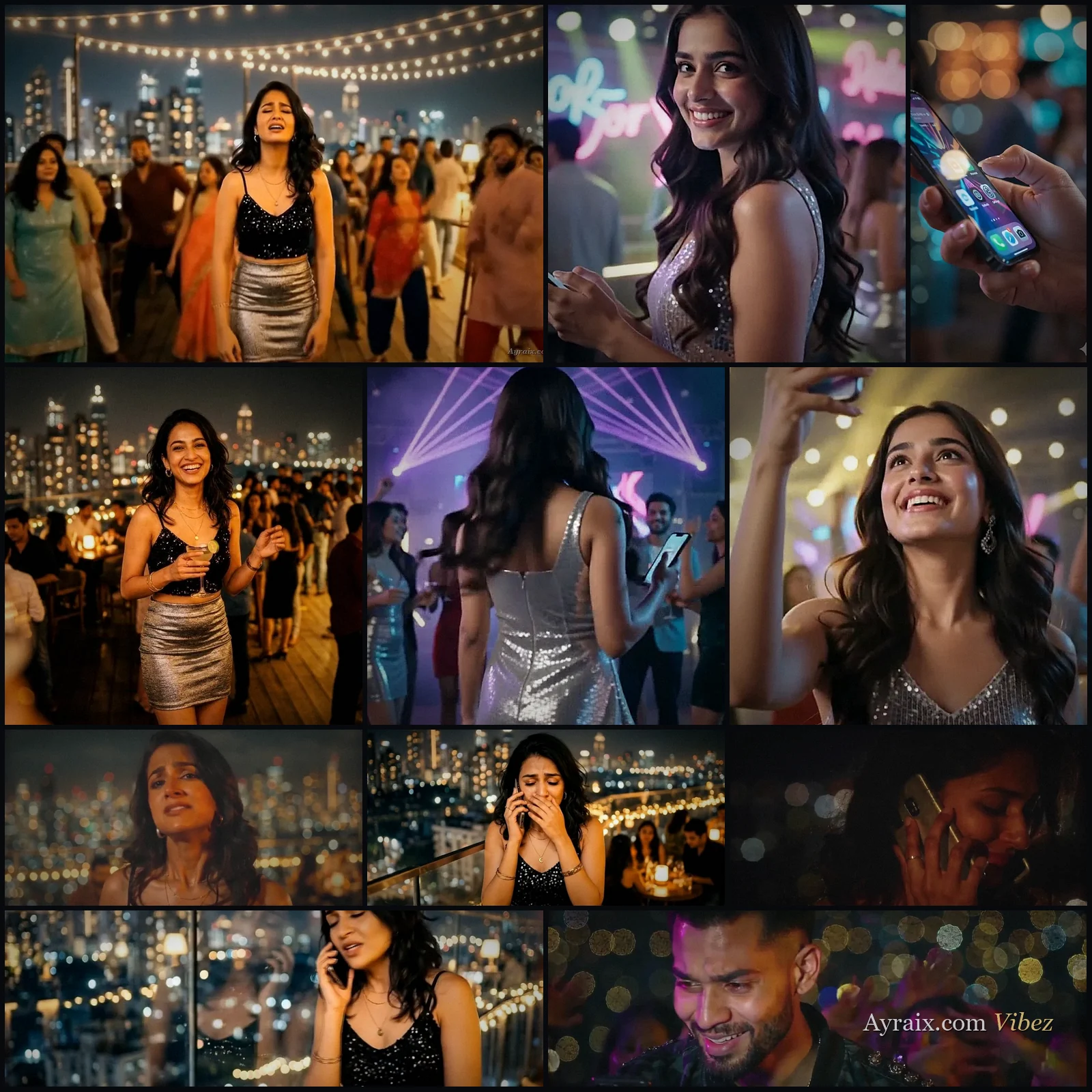
That is the performance. Party vich saheliyan naal nachdi, haath vich phone te floor utte raula — dancing with her girlfriends, phone in hand, noise on the floor. She is the one the camera would follow if it wanted a good time. She is the one nobody thinks to check on.
Then the voice arrives in her ear — achanak aayi teri awaaz kaan vich — and it feels like a stone going through glass. Everything around her keeps moving. Her hand stays on the phone. Her face stays on the beat. Only her inside changes, and no one in that room is looking at the inside.
She runs to the washroom — washroom wal bhaagi crowd de pichhe — and stands in front of the mirror, mirror de aage khad ke suneya, and hears the rest of her life get decided in a language she can't argue with. Her reflection is the only one in the room who knows what is happening — and even she can't look away.
She is not background to the breakup. She is the one the breakup happens to — in the middle of a room full of people.
Party vich kalli khaloyi — in the middle of the party, she stood alone.
The character atlas
Everyone in this story is carrying one kind of silence.
Some of them have faces. One of them is a phone. All of them are trying to answer the same question: how much can a person cry at the loudest party of the year before someone notices?
01 / THE DANCER✦
She dances loud enough to disappear.
She is the protagonist, and she is playing the part of the night's happiest person. The phone is the prop. The smile is choreography. Her real face only exists in the washroom mirror, and even there she keeps it small.
Her tragedy is not that she got broken up with. It is that she had to keep dancing through it — that heartbreak was scheduled for the middle of the loudest song of the year, and the room demanded she stay.
Her wound · having to perform while falling apart
02 / HIM☽
The voice on the other end.
He is almost never on screen, and that is exactly right. By the time the call rings, he has already become a voice — the thing that used to be a person beside her and is now a sentence delivered through a speaker.
Tu bolda pya bas khatam kahani, bhool ja mujhe tu abhi se bolya — you kept saying the story is over; forget me, you said it, right now. The memory of him is warm. The call itself is cold. The song lives in the distance between those two temperatures.
His truth · you don't need to be in the room to end it
03 / THE CALL✆
The quietest thing in a loud room.
The midnight call is the real antagonist. Not him, not the breakup — the call itself. It is the only object in the entire night that refuses to dance. It rings in the middle of the dhol, and the dhol has no answer for it.
A midnight call arrives at the exact hour when the day's noise is supposed to be over. That is its cruelty: it waits until you are surrounded, and then it makes sure you hear yourself.
Its power · it makes a crowded room feel empty
04 / THE CROWD◌
Dhol di thaath te sab nachde.
The crowd is not cruel. It is simply in motion. Dhol di thaath te sab nachde, par mere andar toote kanch ke — everyone dances to the dhol's beat, but inside me there is broken glass.
The crowd gives the song its most painful backdrop: joy so complete that grief has no room to be seen in it. Nobody is dancing wrong. That is what makes it unbearable.
Their limit · they can only see the dance, never the dancer
05 / THE DHOL◉
It keeps playing. That is the point.
The dhol is the truest character in the song because it has no feelings and therefore no mercy. It does not pause for the phone call. It does not slow down for the tears. Dhol bajey par main ro di — the dhol played, and I cried — is not a contradiction. It is the entire emotional engine of the remix.
The beat is the thing that refuses to acknowledge the wound. And the wound, in the middle of that refusal, finally becomes impossible to hide.
Its meaning · some grief has to happen in public, whether the room knows or not
The video
Watch the whole night.
The full video is live — the whole night the call came in, from the first beat to the last line.
The story does not move from love to hate. It moves from being surrounded, to being reached, to realizing that being surrounded and being held are not the same thing.
Beat one · The party
The night is a machine built to not hear you.
Dancing with her girlfriends. Phone in hand. Noise on the floor. The party is not a setting — it is a contract: everyone agrees to be fine until sunrise. She signs it with a smile and a toast.
"Party vich saheliyan naal nachdi, haath vich phone te floor utte raula"Dancing at the party with my girlfriends — phone in my hand, noise on the floor.
Beat two · The voice
Your voice arrives in my ear like a stone through glass.
Midnight. The call. Achanak aayi teri awaaz kaan vich — suddenly your voice is in my ear, and the whole room goes distant in one second. The song does not need a flashback here. The shock is the scene.
She does not drop the phone. She does not stop moving. She just starts listening to something the party can't hear, and from that moment the night has two soundtracks playing at once.
The moment the room goes quiet for one person only.
Beat three · The memory
Warm gold: the flashback she can't dance away from.
The remix dips into the memory the way a camera dips into warm light — the balcony, the rain, the boy on the other end when he was still a person and not a sentence. The present is cyan and magenta, electric and cold. The memory is gold, and gold is the most dangerous color in the song, because it makes the present feel like a wrong turn.
The memory is the warmest thing in a cold night.Present runs cool · memory burns gold
Him — before he became a voice on the other end of midnight.
Beat four · The call
You said we are done tonight.
Tu bolda pya bas khatam kahani — you kept saying the story is over. The English line lands like a verdict: you said that we are done tonight. No argument is offered, because none was invited. The call is not a conversation. It is a delivery.
She runs to the washroom — washroom wal bhaagi crowd de pichhe — and stands in front of the mirror, mirror de aage khad ke suneya, as if the person she has to convince is the one in the glass. The party doesn't know. The crowd doesn't know. She wants to ask ve tu dil tod ke kidhar gaya? — where did you go after breaking my heart? — but the call is already over, and only the mirror has seen her cry.
Beat five · The dhol
Everyone is dancing. My inside is broken glass.
Dhol di thaath te sab nachde, par mere andar toote kanch ke — everyone dances to the dhol, but inside me there is broken glass. Then the hook the whole song has been walking toward, delivered not as a scream but as a confession: dhol bajey par main ro di.
The kajal runs — kajal behta, main bolan ki? — what is she even supposed to say? The world laughs while she walks staggering. She leaves the dance floor — dance floor main chhad ke aayi — not storming out, just walking away from the center of the room toward the edge of it. Party vich kalli khaloyi — in the middle of the party, she stood alone. Bass bajey par dil mera rona — the bass plays, but my heart keeps weeping. The loneliest place in the song is not an empty room. It is the center of a full one.
The toast happened. The night continued. Neither of them noticed she was leaving.
Beat six · The city
The outro belongs to the city.
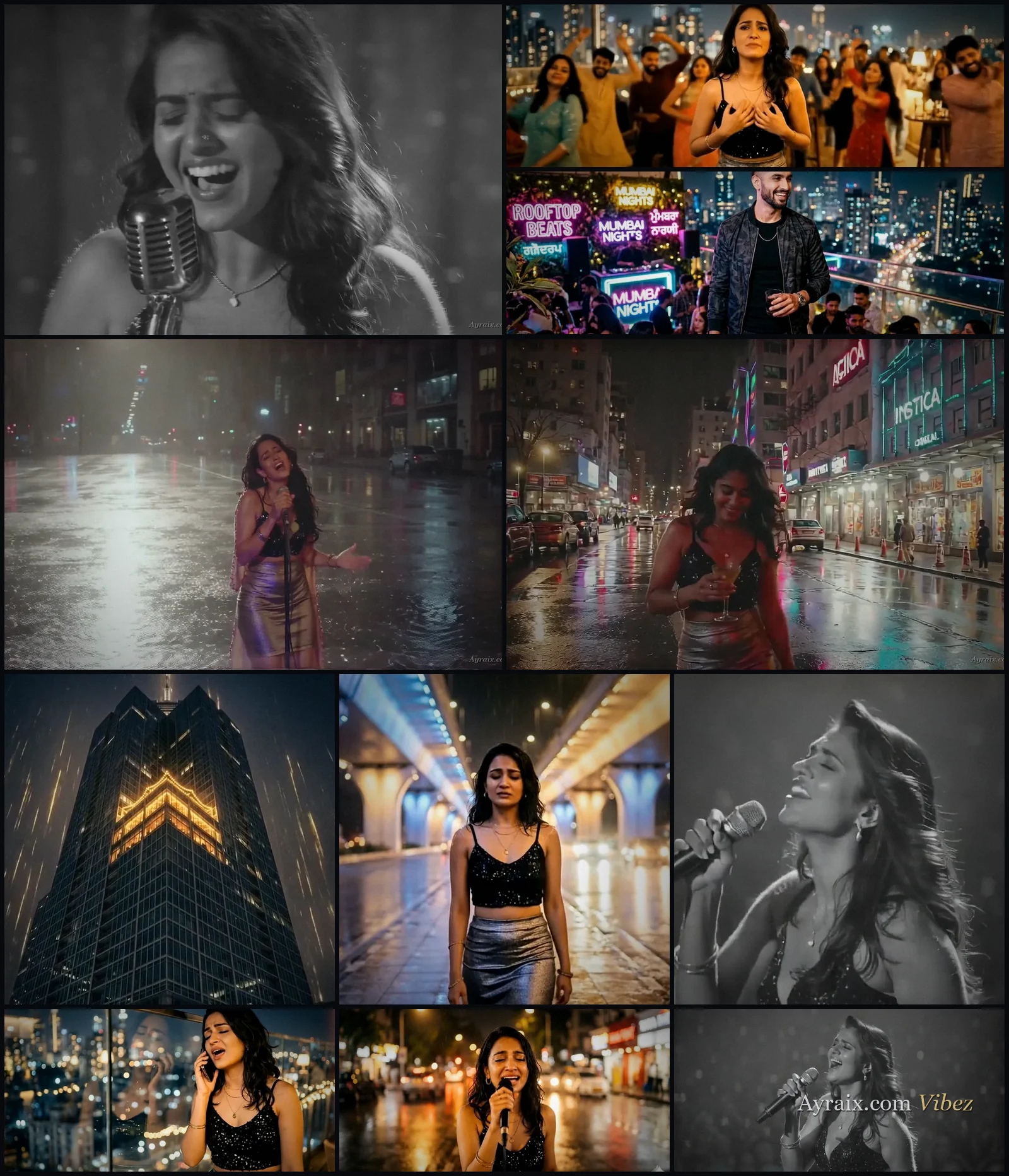
The party ends. The screen widens. Rain on the street, the mic in black and white, the skyline keeping its lights on for nobody in particular. The song's final line is not a threat and not a plea — it is a receipt: Midnight call, you broke my heart, dhol baja par main ro di, ve tu tod gaya, main ro di, we are done tonight.
"Tainu lagda ae... eh sirf mera naseeb si? Nahi... kujh rishtey shor vich nahi, bas... khamoshi ch marde ne."You think this was only my fate? No — some relationships don't die in the noise. They die in the silence. The outro stops singing. That is when she finally speaks.
And then the song stops being a song. I had to let you go... before we destroyed whatever was left of us. The music's still playing... but we're out of time. Main... mudke ni aavangi. I'm not coming back. Sometimes walking away is the only way left to love you.
The city is the last character in the story. It does not know her name. It does not care about the call. It just keeps glowing — which, the song argues, is the most honest response to heartbreak there is: the world does not stop, so neither can you.
After the dhol stops, only the city is still awake.
The song, line by line
For anyone hearing Midnight Call for the first time.
Here is the shape of the female remix as it plays — from the toast, to the call, to the city that keeps its lights on.
Chorus
"Midnight ka call tera aaya / shor mein bhi dil ye ghabraya / you said that we are done tonight / dhol bajey par main ro di." The entire story in four lines: the call, the fear, the verdict, the tears that the beat refuses to cover.
Verse 1
Saheliyan naal nachdi — dancing with her girlfriends, phone in hand. Then "achanak aayi teri awaaz kaan vich": your voice in my ear like a stone through glass. "Ve tera bol kaleja chhed gaya" — your words cut through to my chest. She runs to the washroom and stands in front of the mirror to hear the rest.
Verse 2
Everyone dances to the dhol's thaath while "mere andar toote kanch" — broken glass inside. "Kajal behta, main bolan ki?" — the kajal runs, what can she even say? The world laughs while she walks staggering; she leaves the dance floor and stands alone in the party — kalli khaloyi.
Outro
"Midnight call / you broke my heart / dhol baja par main ro di / khatam kahani / we are done tonight." Then the song stops singing and starts talking: "kujh rishtey shor vich nahi, bas khamoshi ch marde ne" — some relationships die in silence. "Main mudke ni aavangi" — I'm not coming back. The city takes over the frame and the story simply ends.
The memory
Gold-tinted flashbacks of the boy — balcony, rain, the person he used to be. The remix cuts them short, because memories in this song are not comfort. They are the reason the present hurts.
The outro
Black-and-white mic, rain on glass, the skyline at night. The outro of the video: just her, the mic, and the city keeping its lights on.
The central symbol
A dhol doesn't stop because someone is crying.
That is why the line hurts. The dhol is not a punishment. She was never wrong to be at the party. The pain is that the celebration kept its schedule while her heart did not — that the beat was contractually obligated to continue, and so was her smile.
Midnight Call isn't really a song about a breakup. It's a song about the exact moment someone realizes that the world's joy is not contingent on her being okay — that the party will finish, the city will glow, and none of it will have waited for her to catch up. Not because the dhol is cruel. Because it is honest.
The dhol is the noise. The call is the silence. The whole thesis of the remix lives in the gap between the two — in the second when the beat keeps playing and she finally hears herself.
Kujh rishtey shor vich nahi, bas khamoshi ch marde ne — some relationships don't die in the noise. They die in the silence between two beats of the dhol.
What the song leaves behind
The story is not asking you to pick a side.
It is asking you to notice the person in the loudest room who has gone quiet, and to understand why they couldn't leave.
For the one dancing
You are allowed to be the happiest-looking person in the room and still be falling apart. A smile that keeps the night moving is not a lie — it is a shift you were never given a day off from.
For the one who ended it
Some endings are delivered at the worst possible hour — midnight, mid-party, when the other person is surrounded. The call was honest. It was also cruel. Both things can be true, and the song holds both — because sometimes walking away is the only way left to love someone.
For the ones watching
The person dancing the hardest may be holding the most still. Check on the one who looks happiest. The dhol won't tell you who's crying — you have to look past the beat.
Behind the scenes
Pictures from the shoot.
Two mosaics from the female remix — the night before the call, and the long way home through the rain. Tap either collage to open it full-size.
01 Before the call · the party
The party, then the call. Eleven frames from the first half of the night.
02 The rain & the city
After the call. The breakdown, the wet street, the tower, the mic.
The outro reel: black and white, just her and the mic.
Maybe the midnight call is not the end of the story. Maybe it is the moment she finally hears herself — over the dhol, over the crowd, over the part she was playing.
Midnight Call · dhol bajey par main ro di · Ayraix Vibez
Ayraix Vibez · single
Midnight Call — female remix
The second original release from Ayraix Vibez, told the way we tell everything else: honestly, and without the hype. The track is ready to play above, and the full video is on YouTube now.
Female remix2:31Punjabi · Hindi · EnglishSoft captions