MCP Is the New API — And You Haven't Wired It Yet
Model Context Protocol is becoming the USB-C of AI integrations. One wire format, one discovery mechanism, one permission model.
Anjali's team had built three different integrations for the same SAP revenue endpoint in eighteen months — one for the chatbot, one for the reporting agent, one for the executive dashboard. Each one broke on a different Friday. "There has to be a wire format," she said, "that every tool speaks so we build it once." That wire format is MCP. Model Context Protocol is the beginning of a standard plug shape for AI tools. Every vendor ships their own connectors, every internal team wraps their database in a one-off Python function, every agent framework reinvents tool calling. MCP says: one wire format, one discovery mechanism, one permission model.
Why this matters now
Agents without tools are chatbots with ambition. Agents with twelve incompatible tool interfaces are production incidents waiting for a calendar invite. MCP gives you a catalog: the host asks "what can you do?" and the server answers with typed capabilities, schemas, and boundaries. Swap Jira for Linear? Swap Postgres for Snowflake? The agent's mental model stays stable if both speak MCP.
What this means for you: if you're building internal AI this year, don't wrap your fifth API in custom glue. Build or adopt an MCP server. Your future self — and every agent you deploy — will treat that decision like choosing HTTP over proprietary RPC.
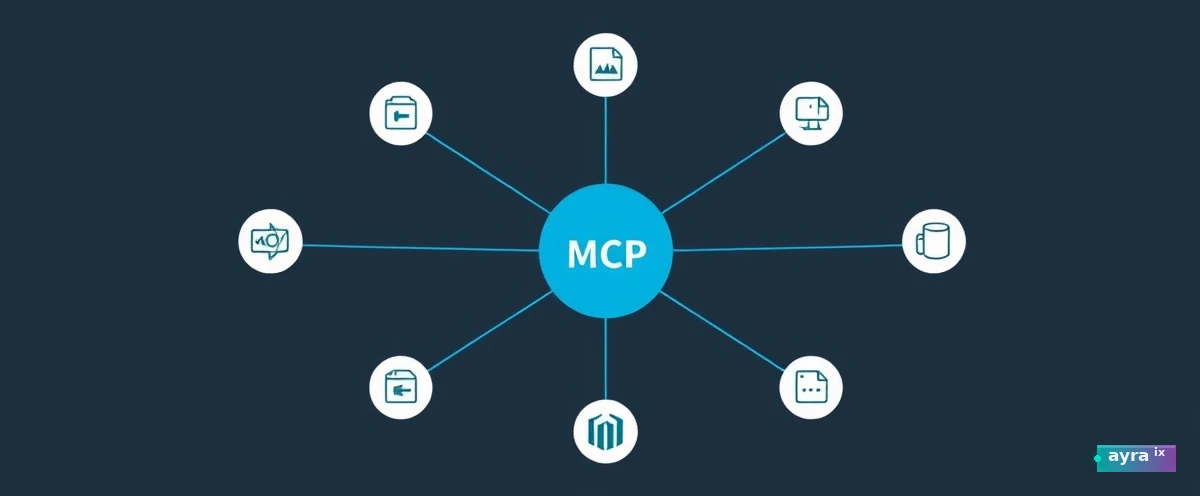
A host discovers tools, calls them with structured input, and gets structured output — across processes, languages, and networks.
The architecture that actually ships
Start narrow. One MCP server per domain: finance read-only, HR ticketing, document search. Run them as sidecars or local processes — not because MCP requires it, but because blast radius matters. An agent that can read everything shouldn't get write access because someone merged a permissive config on Friday.

- Discovery first — agents list tools at session start; no hardcoded function names in prompts
- Typed boundaries — JSON schemas beat "please return JSON" in the system prompt
- Human gates on writes — MCP doesn't remove judgment; design approval into destructive tools
- Version your servers — like any API, breaking changes need migration paths
MCP won't make your agent smarter. It makes your stack legible to agents — which is rarer and more valuable.
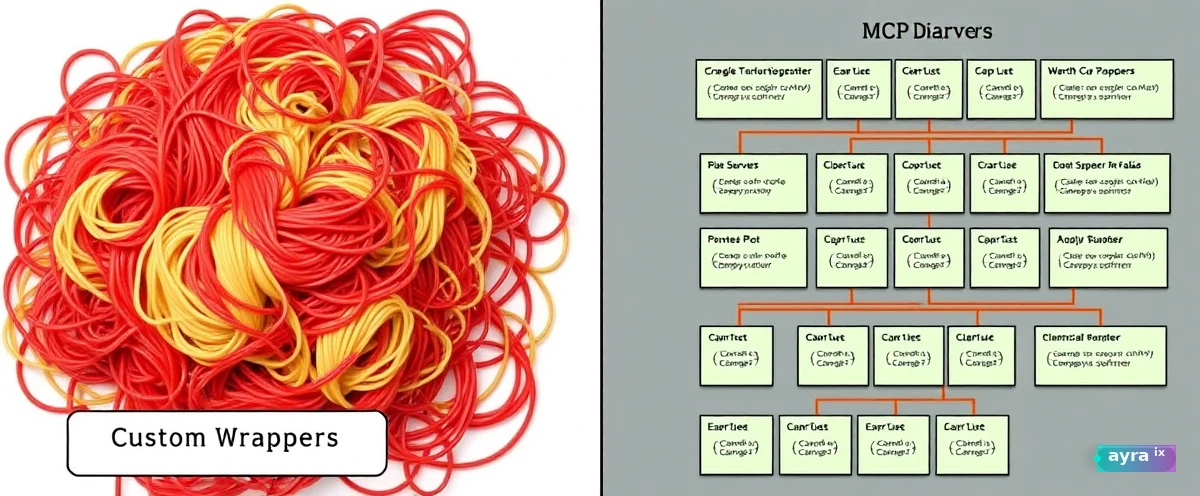
| Custom wrappers | MCP servers | |
|---|---|---|
| New integration | Days per source | Hours with existing patterns |
| Agent portability | Locked to one framework | Host-agnostic |
| Discovery | Hardcoded in prompts | Dynamic catalog |
| Ops ownership | Scattered scripts | Versioned services |
What to do this week
Pick one painful integration — the one your team re-explains every sprint. Wrap it as an MCP server with read-only scope. Point your agent host at it. Measure time-to-add-tool-number-two. If it drops, you've found your platform bet.
Where MCP fits in your existing stack
You probably already have three half-finished integration patterns: a LangChain tool wrapper someone wrote in a hackathon, a Zapier webhook the ops team refuses to maintain, and a "temporary" REST shim in front of your data warehouse that's now load-bearing. MCP doesn't delete those overnight — it gives you a migration target with a name vendors and hosts can agree on.

Here's the thing: treat MCP servers like microservices for agent capabilities. Each server owns a bounded context, exposes a schema, and logs every invocation.
- Host choice — Claude Desktop, Cursor, custom orchestrators; MCP travels with you
- Transport — stdio for local dev, SSE or streamable HTTP when you need network isolation
- Auth patterns — OAuth for SaaS, mTLS for internal, API keys only in dev sandboxes
- Observability — trace tool calls like HTTP requests; you'll debug agents the same way
Common mistakes on week one
God-server syndrome — one MCP process with forty tools and admin credentials. Split it. Prompt-defined tools — hardcoding function names in system prompts while claiming MCP adoption. Discovery exists for a reason. Write tools on day one — read-only first, always. You can add destructive capabilities after you trust the audit trail.
What this means for you: schedule a lunch-and-learn where engineering demos one real MCP server calling one real internal API. Not slides — a live tool list, a live invocation, a live log line. That fifteen minutes converts more skeptics than another "AI strategy" deck.
When your second MCP server takes less time than your first, you've crossed from experiment to platform.
Vendor landscape and internal politics
Every platform will claim MCP support in the slide deck. Your job is to ask which tools, which auth, which SLA — and whether their server runs in your VPC or phones home. Internal politics matter too: the team that owns the data API may resist wrapping it for agents. Frame MCP as reducing their support burden ("one integration, many hosts") not as AI hype stealing budget.
What this means for you: publish an internal MCP registry — server name, owner, scope, last security review. Agents discover from the registry; shadow servers get blocked at the gateway.
The USB-C metaphor is overused but accurate: the winners won't be the ones with the most exotic connectors. They'll be the ones where everything snaps in.
The teams winning on MCP aren't the ones with the most servers — they're the ones whose servers survive a security review.
Your move: Before next sprint, expose one internal tool or API as an MCP server — even if nobody calls it yet. The exercise of modeling a capability as tools with schemas will surface design decisions your REST API hid. Once the MCP server exists, your agents can discover and call it without custom integration code. That discovery loop is the whole point.
Stay with us · pushback
MCP's Promise: A Unified Approach for AI Tools?
What do you think is the biggest challenge in adopting MCP across different domains and tools? Share your thoughts!
No account needed — pick a take, then keep reading. We rotate these prompts so each piece feels like a conversation, not a clone.