Multimodal AI in Production: The Reality Behind the Demos
The demo screenshot is always crisp, well-lit, and free of confidential watermarks. Your production inbox is scanned invoices at 72 DPI, rotated sideways.
The demo screenshot is always crisp, well-lit, and conveniently free of confidential watermarks. Your production inbox is scanned invoices at 72 DPI, rotated sideways, with a coffee ring. Multimodal isn't a model choice — it's a pipeline bet.
Elena's team spent three months fine-tuning a vision model on crisp product photos. The first production upload was a 72 DPI scanned invoice, rotated 90 degrees, with a coffee ring obscuring the total amount. The pipeline starts with your worst input, not your best demo.
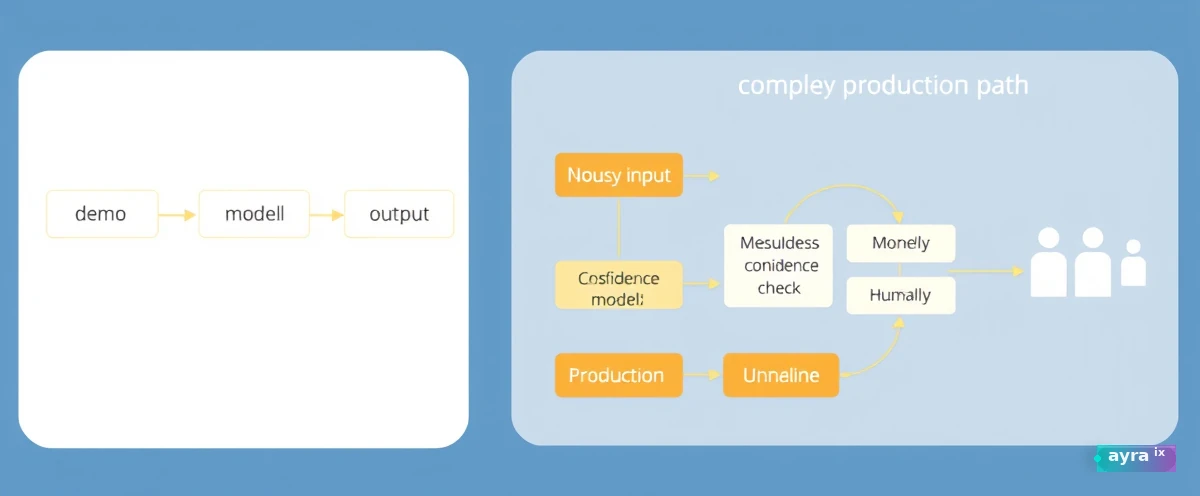
Here's the thing: the vision model is the easy part. Hard parts are ingestion (format chaos), pre-processing (deskew, denoise, page split), routing (when to OCR vs. when to pass pixels), and human review for anything that touches money or compliance. Skip the pipeline and you don't have multimodal AI — you have expensive guessing.
Design for the worst input
Start eval sets from production failures, not stock photos. Measure accuracy per document type, per scan source, per language. Confidence thresholds should route low-quality extractions to humans — not to downstream automation.

Can you explain why the model got page 47 wrong — and fix it without retraining?
| Stage | Demo | Production |
|---|---|---|
| Input | Clean PNG | PDF, fax, photo |
| Pre-process | Skipped | Deskew, split, redact |
| Failure | Hidden | Routed to human queue |
Audio and video add consent, retention, and latency problems text never had. Multimodal expands your compliance surface, not just your feature list.
Audio and video: the compliance iceberg
Vision demos get the keynote slot. Audio and video get the legal review that never finishes. Recording consent, retention periods, biometric sensitivity in some jurisdictions — multimodal expands your compliance surface faster than your feature list. Text pipelines had decades of precedent; camera and microphone pipelines inherit none of that maturity in most enterprises.
Here's the thing: if you can't answer "where are the frames stored, for how long, and who can replay them," you don't have a feature — you have a liability with a progress bar. Design deletion into the pipeline, not as a post-launch ticket.
- Consent capture — explicit for call recording; implied isn't enough in many regions
- Redaction first — faces, badges, screen reflections before model sees pixels
- Segment boundaries — chunk video by speaker turn, not arbitrary frame batches
- Fallback transcripts — when vision fails, ASR + text pipeline may be cheaper and safer
Multimodal production isn't failing on model quality — it's failing on ingestion hygiene and consent paperwork.
Building a failure museum
Collect your worst inputs — blurry scans, folded corners, fax artifacts, phone photos at weird angles. Label ground truth manually. This museum becomes your regression suite, not your marketing assets. Vendors benchmark on pristine data; you ship on Monday's mailroom.
What this means for you: route low-confidence extractions to a human queue with the original artifact attached. Measure correction rate per source — if one scanner model produces 40% of your errors, fix the scanner or the pre-process, not the LLM. Multimodal maturity is operational, not a model version number.
No multimodal feature ships without a labeled failure set and a human review path.
Vendor bake-offs on your scans
Bring vendors your failure museum, not their sample PDFs. Score extraction field-by-field with tolerance rules — currency formats, date locales, handwritten annotations. The model that wins on clean demos often loses on your mailroom.
What this means for you: contract for accuracy on your eval set, not theirs. Include pre-processing requirements in SOW — if you need deskew and denoise, say who owns it. Multimodal projects fail at handoffs between teams, not at model selection.
Latency budgets across the pipeline
Vision inference is one line item. Pre-process, upload, queue, post-validate often dominate p95. Measure end-to-end from camera shutter to structured JSON in your database — not model-only benchmarks.
What this means for you: parallelize pre-processing where safe. Cache deskew results for re-tries. Multimodal SLAs are pipeline SLAs; optimize the slowest stage first.
Ship multimodal with a human queue, a failure museum, and a pre-processing owner — or ship a demo.
What this means for you: tie launch criteria to field accuracy on worst scans, not lab F1. Production sign-off is ops sign-off.
For text-heavy multimodal fallbacks, pair vision with structured extraction tools — even our Expense Summarizer shows how far you get when inputs are normalized before the model sees them. Same lesson, bigger files.
Build the failure museum before the feature
The demo PNG was never going to prepare you for Monday's mailroom — the rotated fax, the coffee ring, the phone photo at an angle. What this means for you: start collecting your worst real inputs now, label them by hand, and treat that pile as your actual regression suite. A model that scores well on a vendor's clean sample PDFs has told you nothing about your scanned invoices.
Here's the thing: pair that failure museum with a human queue for anything low-confidence, and name someone who owns pre-processing. Multimodal maturity shows up in ingestion hygiene and consent paperwork, not in another point release of the vision model.
Your move: This week, dig five of your worst production inputs out of the logs — the image that broke the pipeline, the scan the model got wrong, the fax that made someone say "let's just have a human do it." Label them with ground truth by hand. Run them through your current pipeline. Measure where each one fails: ingestion, pre-processing, or inference. That five-item report tells you more about your multimodal system than any benchmark dashboard.
Stay with us · pushback
How Realistic Are Your Multimodal AI Demos?
Have you ever noticed a significant gap between the crisp, well-lit demos of multimodal AI and its performance in real-world production environments? Share your thoughts!
No account needed — pick a take, then keep reading. We rotate these prompts so each piece feels like a conversation, not a clone.