
Composite — self-checkout lane, any big-box Saturday. She bags produce while a ceiling dome watches the cart. A return earlier that month left a quiet flag somewhere in the stack. Nobody says “gait” or “emotion.” The receipt still prints. The privacy line moved without a press conference.
Retail AI surveillance has advanced faster than consumer awareness or regulation. Loss-prevention and “customer journey” stacks mix computer vision, return scoring, dwell-time heatmaps, and third-party identity graphs. Vendors pitch expression cues and gait re-identification as ordinary merchandising — usually buried in terms of service. Treat named-chain war stories and certainty about every modality as composite: the capability set is real and expanding; which stores run which features varies; consent theater is thin. Shrinkage decks claiming neat double-digit lifts are sales literature, not audited public stats. This is the consumer-side cousin of athlete biometric consent — different power relationship, same move from observation toward ownership of the signal.
The Invisible Gaze
What is clearly deployed today is computer vision for shrink, queue, and path analytics — cameras that already look like “security,” plus software that turns dwell and pick-up/put-back into scores. What vendors sell next includes expression classification and gait-style re-identification: persistent identifiers that need no loyalty card. Do not flatten the pitch deck into a census. Expression and gait modules are real research and real product categories; universal aisle deployment as settled fact is overclaim. The honest story is directional: the stack is expanding from “did they steal?” toward “who is this body, how do they feel, will they buy?”
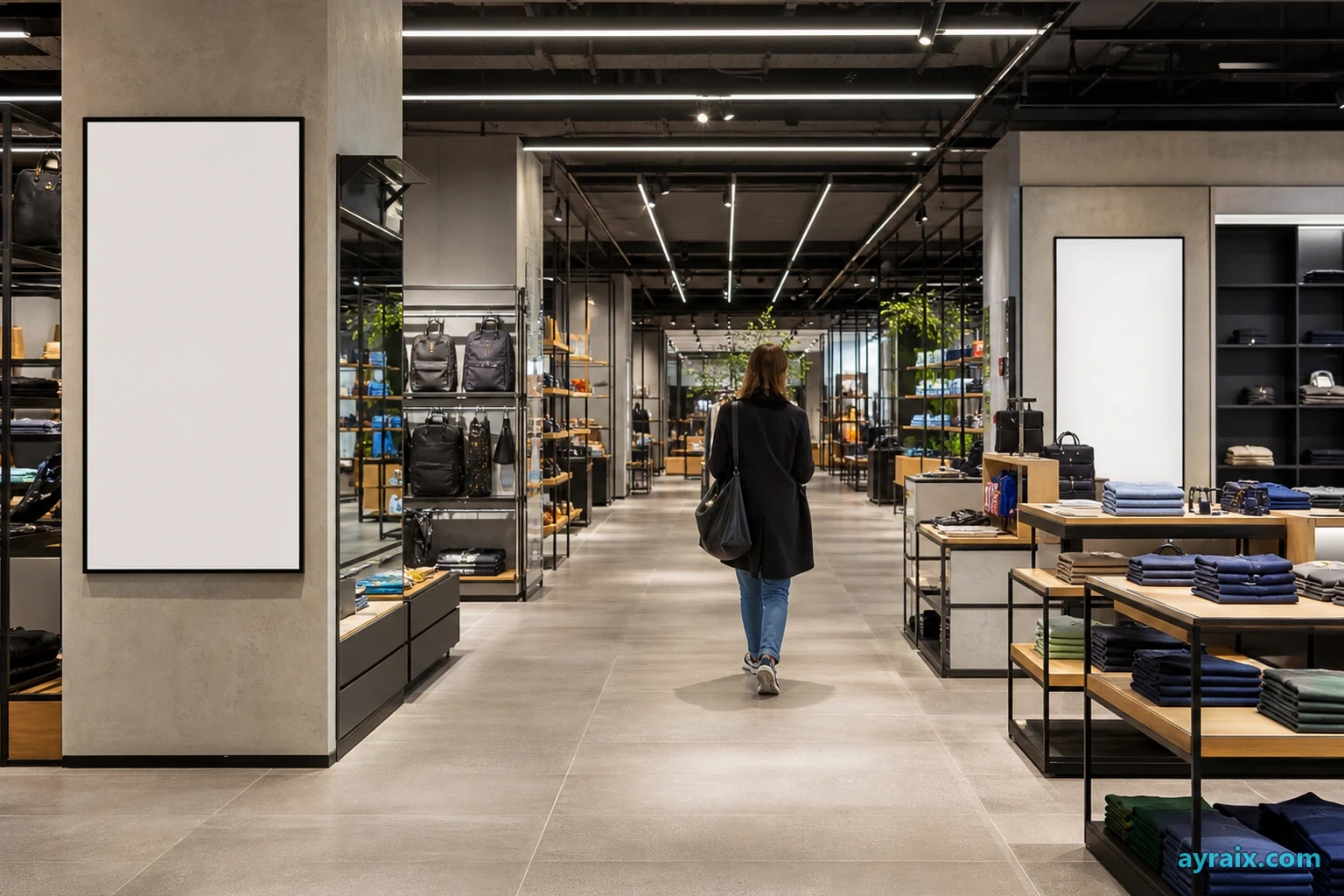
Most shoppers have no idea how far beyond “security cameras” the stack can go. Domes look ordinary. Signage rarely explains expression scoring or biometric re-identification when those modules are on. Opt-in for advanced biometrics is the exception, not the default. The surveillance is invisible by design — not because retailers are hiding it, but because they have calculated that visible surveillance would change customer behavior in ways that defeat the purpose of the analytics. The irony is that the entire system depends on natural, unguarded behavior. The moment shoppers know they are being watched at this level of granularity, the data loses its predictive value.
What Retailers Know About You
The scope of data collection from a single shopping trip is staggering. Entry time, dwell time per aisle, items picked up and put back, route through the store, time spent at the shelf, payment method, exit time — and, where vendors enable it, inferred expression or identity cues. When linked to a loyalty card or credit card, these data points attach to a name, address, full purchase history, and — in an increasing number of cases — demographic inferences drawn from appearance and behavior.
The privacy implications extend beyond the individual trip. Data permanence means a single visit creates a profile that persists indefinitely. Retailers are not deleting this data. They are building longitudinal profiles that track changes in behavior over months and years. A customer who visits a store weekly for two years generates over 500 discrete data points, each one adding resolution to a portrait that the retailer knows better than the customer knows themselves.
Secondary use is perhaps the most insidious problem. Data collected for loss prevention — including any expression or path scores at self-checkout — can be repurposed for marketing segmentation, store layout optimization, or even employee performance evaluation. The customer who agreed to shop at a store did not agree to be a data subject in an ongoing behavioral research study. But the legal framework treats the absence of explicit prohibition as permission.
The Data Broker Connection
The most concerning development in retail AI surveillance is the integration of in-store tracking data with third-party data broker profiles. Retailers are purchasing credit score ranges, estimated income brackets, property ownership data, and even social media activity scores from data brokers — and correlating all of it with in-store behavior patterns captured by AI cameras.
The result is a comprehensive profile that combines what you do in a store with who you are outside of it. A customer who spends extra time in the premium wine aisle and whose credit score suggests disposable income may receive targeted offers on their phone before reaching the checkout. A customer matched to a prior-return risk model — via loyalty, device, or (where deployed) biometric re-ID — may be quietly flagged for enhanced attention. Queue routing and offer targeting can already differ by inferred profile without the shopper knowing why.
This feedback loop between physical surveillance and data broker enrichment creates a system that knows more about shoppers than shoppers know about themselves. And unlike online tracking, which consumers have learned to manage with ad blockers, VPNs, and private browsing, in-store surveillance has no equivalent countermeasure. You cannot install a browser extension for the physical world.
Where the Line Should Be Drawn
The regulatory response to retail AI surveillance has been fragmented and insufficient. The EU's General Data Protection Regulation provides strong protections for biometric data, classifying it as sensitive personal information that requires explicit consent. The United States has no equivalent federal law. The patchwork of state regulations — the Illinois Biometric Information Privacy Act (BIPA), the California Consumer Privacy Act (CCPA), the Virginia Consumer Data Protection Act — provides limited protections, but compliance is inconsistent and enforcement is rare.
The retail industry's self-regulatory efforts have been voluntary, unenforceable, and insufficient. Trade associations have published "best practice" guidelines that recommend transparency around data collection but stop short of requiring consent. The guidelines are aspirational. The technology is operational. The gap between what retailers say they will do and what they are already doing is measured not in policy disagreements but in the millions of shoppers being profiled every day without their knowledge.
The line should be drawn at three points. First, biometric analysis — including facial expression detection, gait recognition, and emotion classification — requires explicit, informed consent before data collection begins. Not buried in a terms-of-service agreement. Not assumed through continued presence in the store. An active, unambiguous opt-in. Second, data collected for one purpose cannot be repurposed for another without separate consent. The data generated by loss prevention systems cannot be used for marketing. The data generated by customer analytics cannot be sold to data brokers. Third, surveillance profiles need mandatory deletion schedules that prevent indefinite profiling. A bright-line example — destroy inactive profiles after roughly a year without engagement — is a policy proposal, not current universal law. Without some deletion clock, “analytics” becomes permanent behavioral memory.
These are not radical proposals. They are the minimum conditions for privacy in a world where every store is a data collection platform. The alternative — accepting retail AI surveillance as the new normal — means accepting that the privacy line has not been crossed but erased, one self-checkout camera at a time.
What to watch: the next state-level biometric privacy bill. If it follows the Illinois BIPA model of strong consent requirements and private right of action, it will slow retail AI surveillance deployment. If it follows the industry-preferred model of voluntary disclosure and no enforcement mechanism, the surveillance will accelerate. The legislative choice is also a cultural one: whether privacy in public is a right or a relic.