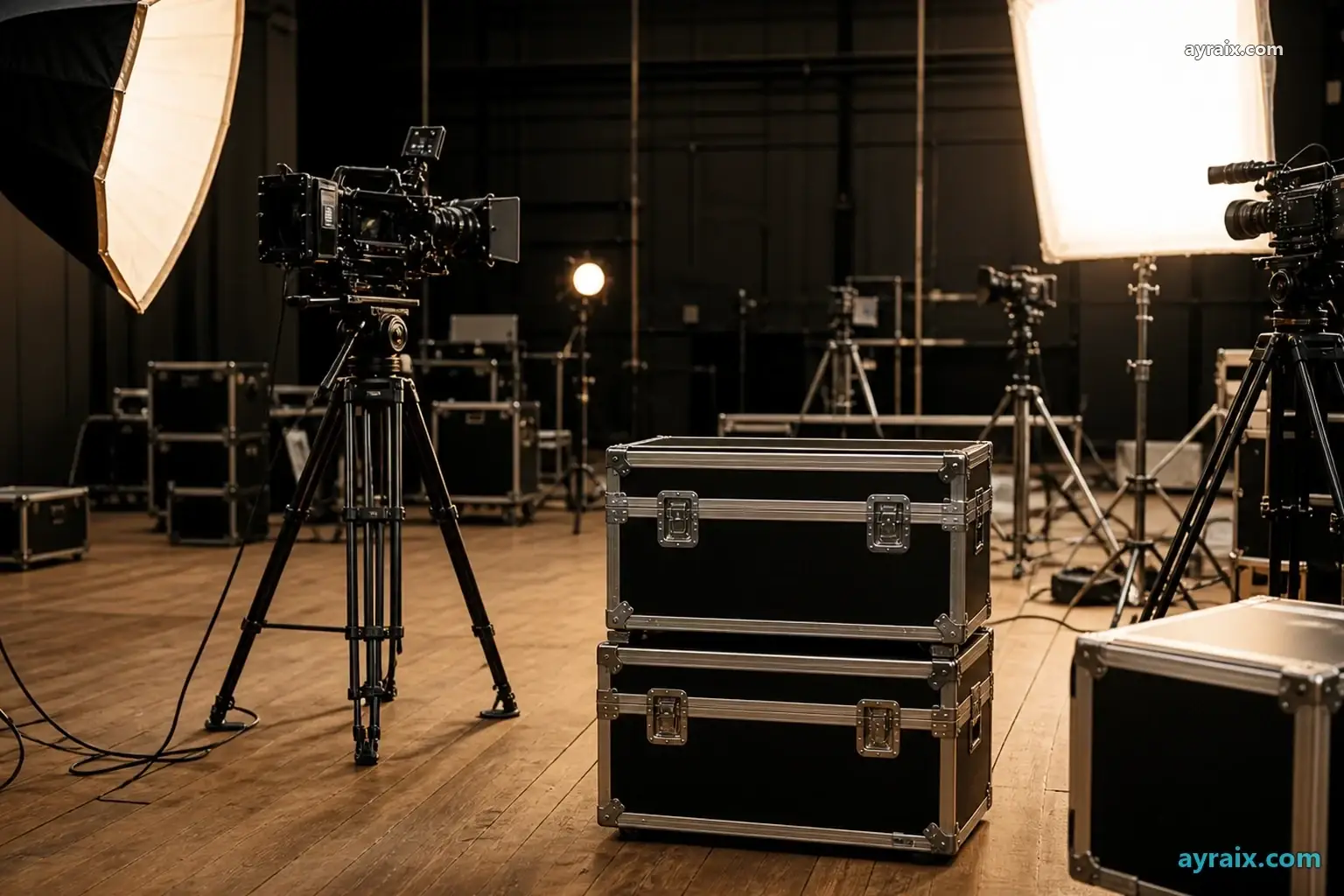
Composite — sound stage, lunch break. Background actors compare call sheets while a producer demos a crowd-fill tool that never needs craft services. Late July 2026 — Los Angeles. The 2023 SAG-AFTRA strike forced AI onto the bargaining table: consent for digital replicas, pay floors for AI-touched background work, and a framework studios promised would be “the template.” Nearly three years on, the template is being stress-tested in casting rooms and VFX pipelines that look nothing like the press-conference version. This piece is about union lines and extras — not Billboard charting AI personas (that’s the music-rights fight) and not creator-feed burnout.
Three years later, the template has been stress-tested. The results are sobering even without invented compliance percentages. Background-actor consent is often respected in name and strained in production reality. Digital-replica protections the union fought for still leave workarounds the size of a soundstage. And a newer category — the fully synthetic performer that never existed as a human — sits awkwardly outside the spirit of a deal written for replicas of living people. The 2023 deal gave the union a framework, not a fortress. The real fight was never about whether AI would perform. It was always about who owns the data, how residuals are calculated, and what "consent" means when technology moves faster than ink dries.
The Contract That Wasn't
The 2023 SAG-AFTRA agreement established two key categories for AI performers. A "digital replica" is a digital copy of an existing human performer — scan an extra, then use that scan in future productions. A "synthetic performer" is generated entirely by AI, not based on any specific real person. For digital replicas, the contract requires informed consent and minimum compensation. For synthetic performers, the rules are looser — the union gets consulted, but the studio retains significant latitude.

Here is where the contract breaks. Studios quickly realized that the digital replica framework was expensive and legally encumbered. Informed consent meant individual negotiations, paperwork, and the risk that an actor would say no. The synthetic performer category, by contrast, had fewer frictions. The result was predictable: studios shifted investment from digital replica technology to synthetic performer generation. Why pay an extra for consent when you can generate a crowd scene that never existed? The contract was designed for a technology that was already being superseded. By the time the ink was dry, the industry had moved on.
Likeness vs Performance: The Legal Distinction That Matters
The most consequential legal distinction in the SAG-AFTRA contract is not between human and AI performers. It is between likeness and performance. Likeness is a static asset — a photograph, a scan, a voice sample. Performance is dynamic — the timing, the inflection, the creative choices that make a scene work. The contract provides strong protections for likeness. It provides almost none for performance.
Consider a background actor who is scanned for a single scene. The contract requires that the actor consent to that specific use. But nothing in the contract prevents the studio from taking that scan, feeding it into a performance model, and generating new "performances" — new gestures, new expressions, new interactions — that the actor never agreed to. The scan is the same. The performance is not. The contract protects the static asset. The dynamic output is unregulated.
This is not an oversight. It is a structural feature of a contract negotiated by people who understood photography better than they understood machine learning. A photograph captures a moment. A performance model generates infinite moments from a single capture. The legal framework treats them as equivalent. They are not.
Residuals for Nobody
The residuals question — who gets paid when a synthetic performer generates revenue — is the third rail of AI and entertainment. Under the current contract, residuals for digital replicas flow to the human performer whose likeness was used. For synthetic performers that are not based on any specific person, residuals go into a union-controlled fund that is distributed broadly. The theory is sound. The practice is not.
The problem is attribution. When a synthetic performer appears in a film, a streaming series, and a video game adaptation, the contribution of any single training data point is essentially untraceable. If a model was trained on 10,000 actors to generate a single synthetic background performer, who owns the residual claim? The contract assumes a clean chain of causation — this performer, this performance, this payment. AI breaks that chain. The result is that synthetic performer residuals are being calculated using methods that both sides admit are inadequate. Studios underreport. The union under-enforces. The performers who contributed training data receive nothing because their individual contribution cannot be measured.
The irony is that the music industry already lived this. When sampling became central to hip-hop, the legal framework took years to catch up — and the result was a system where sample clearance is expensive, litigious, and favors major labels over independent artists. The film industry is repeating the same mistake. It is negotiating for the last technology while the next wave — real-time synthetic performance, AI-driven animation, personalized AI actors — is already in production.
What the Next Strike Will Be About
The 2026 contract renegotiation is already being framed around three issues. First, closing the synthetic performer loophole — the contract needs to treat AI-generated performances as a compensable category regardless of whether they are based on a specific human. Second, establishing tracing and attribution standards for training data contributions. Third, creating a residual framework that works for aggregated, model-based performances rather than individual, capture-based ones.
Behind all three is a more fundamental question that the industry has been avoiding: what is a performer in the age of AI? If a synthetic actor generates a performance that no human ever performed, who is the performer? The model creator? The studio that commissioned it? The data subjects whose training data made it possible? The current contract punts on this question entirely. The next one cannot afford to.
The strike that doesn't happen is the one that matters most. If the next SAG-AFTRA negotiation produces a quiet extension of the current framework with minor tweaks, the industry will have signaled that it is not ready for the AI transition. If it produces a fundamental restructuring of how performance is defined, attributed, and compensated, it will be the most important labor agreement in entertainment history. The difference between those outcomes is not about whether the union is strong. It is about whether the union understands what it is actually negotiating over.
What to watch: not the picket lines, but the training data licenses. If the next contract requires studios to disclose what data their AI models were trained on, the transparency win is real. If it allows proprietary data sets to remain opaque, the contract is theater. The consent form is the battlefield. Everything else is noise.