
Composite — 1:14 a.m., ring light still on. She finishes the third cut of a twenty-second video, posts, replies to twenty comments, and opens analytics that already look colder than yesterday. The caption she almost wrote — “taking a week off” — stays in drafts because last time a quiet week was not rest. It was algorithmic exile. Tomorrow she will do it again. Platform earnings calls still celebrate record engagement. Creator forums and exit essays tell the other half: short careers, cadence pressure, a replacement queue that never empties. Invented single-study percentages are easy; the pattern is harder to deny.
Creator burnout is not a bug in the platform business model. It is a structural requirement. The economics of social media platforms depend on a continuous supply of fresh content at a volume that exceeds what any individual creator can sustain. The platforms have built algorithmic reward systems that optimize for cadence — daily uploads, hourly posts, constant engagement. These systems do not penalize burnout because burnout is not a cost the platforms bear. When a creator burns out, the platform does not lose content. It gains a slot in the feed that a new creator fills, drawn by the same algorithmic incentives that consumed their predecessor. The system is not designed for creator longevity. It is designed for feed density.
Bridge the scene: the platform did not email her a threat. It simply stopped recommending her to people who used to watch. Silence is the enforcement mechanism. She learns the rule without a policy page — post or disappear — and that lesson is more reliable than any wellness tip in the creator academy.
The Cadence Imperative
The algorithmic logic is straightforward but brutal. Platform recommendation systems optimize for engagement per session. More content from a single creator increases that creator's probability of appearing in a user's feed, which increases their engagement, which increases their algorithmic visibility, which increases the pressure to produce more content. The feedback loop creates a minimum viable cadence — a rate of content production below which a creator's reach collapses. That minimum cadence has been rising steadily as the total content supply increases. What was a twice-weekly posting schedule in 2020 is now a daily-or-more requirement in 2026.
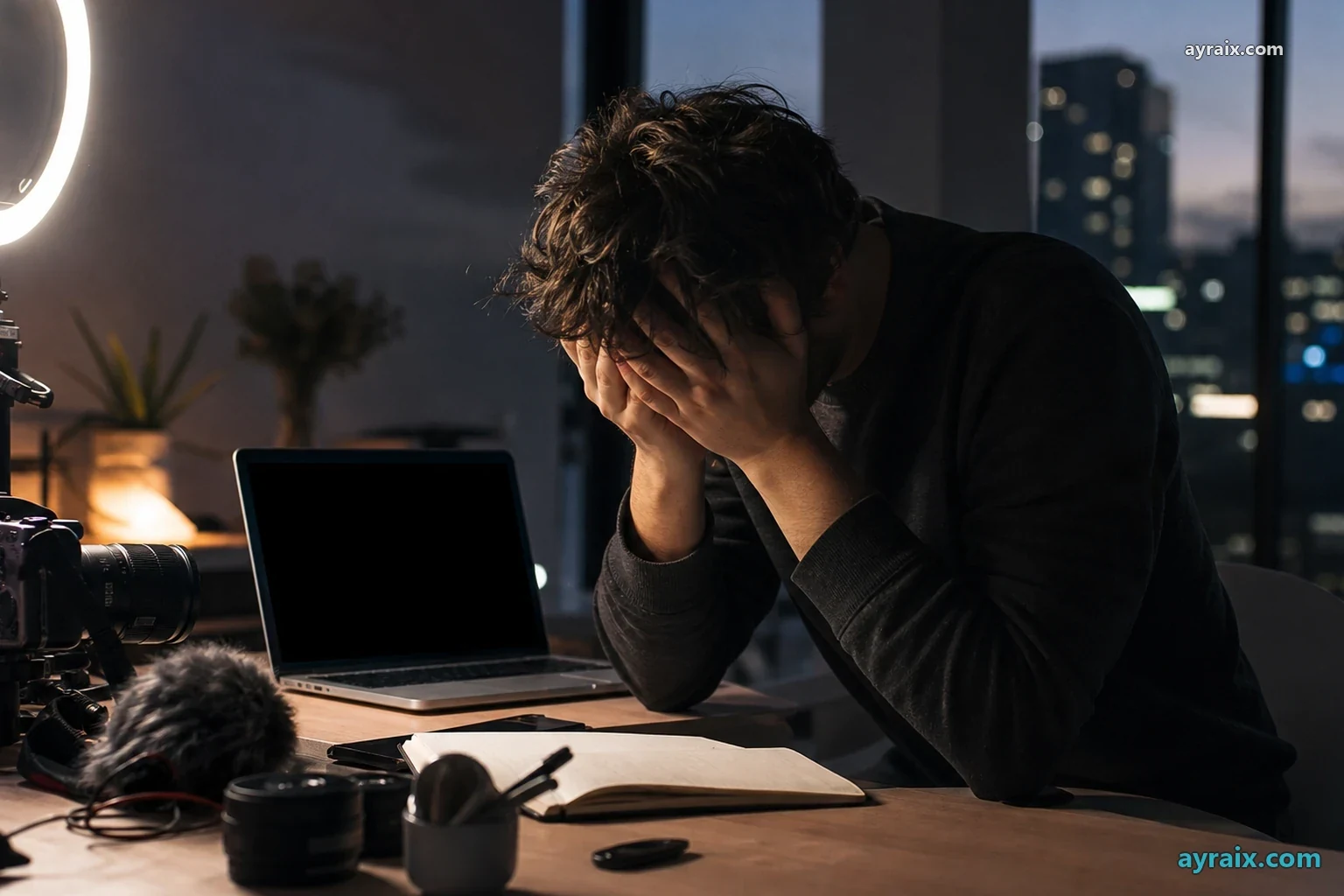
Creators respond to this pressure in predictable ways. They reduce production quality per piece of content, outsourcing or automating the parts of the creative process that can be delegated. They expand their content categories, moving into adjacent topics where they have less expertise but the algorithms reward breadth. They work longer hours, compressing the creative process into a cycle that leaves no room for research, reflection, or recovery. The result is a feed that is denser than ever, filled with content that is adequate but increasingly homogeneous — optimized for algorithmic engagement rather than human value.
Why Burnout Is Structural, Not Accidental
The claim that creator burnout is a bug assumes that platforms would prefer a sustainable ecosystem where creators thrive over the long term. That assumption does not hold. The platform business model has no structural preference for creator longevity. Its preference is for content supply continuity — the steady flow of new material that keeps users engaged and advertisers spending. Whether that flow comes from long-term creators or short-term replacements is irrelevant to the model. The platform's relationship with any individual creator is fungible. Its relationship with the total content supply is existential.
The replacement pool math confirms this. For every creator who burns out and leaves after a short full-time run — often described anecdotally as a couple of years, not a verified universal “2.4-year median” — there are multiple new creators ready to take their place. Treat precise tenure averages as directional folklore unless a named, auditable study is cited. The barriers to entry are low — a smartphone, an internet connection, a willingness to perform for an algorithm. The total addressable creator population is enormous. The platforms do not need to retain creators. They need to maintain the pipeline. The pipeline is not threatened by burnout. It is sustained by aspiration.
The Replacement Pool Math
The economics of content supply work differently from traditional labor markets because the marginal cost of adding a new creator to the platform is near zero. There is no training cost, no hiring process, no commitment. The platform's infrastructure — the feed algorithm, the ad server, the recommendation engine — processes every creator identically regardless of experience. A new creator's first post competes on exactly the same algorithmic terms as a veteran creator's thousandth post. This structural equality creates a perverse incentive: platforms benefit from high creator turnover because new creators are more likely to accept unfavorable revenue splits, work longer hours, and produce the most algorithm-friendly content before they develop the audience relationships that give them negotiating leverage.
Platform payment disclosures and creator surveys often show an early spike in earnings during the first stretch of full-time activity — then flattening or decline as cadence pressure rises and audience novelty fades. Treat any precise month-range as pattern language, not a universal ledger. The platforms' revenue-share arrangements still tend to capture more value as creators become dependent on distribution they do not control. New creators, desperate for visibility, accept terms that experienced creators would reject. The churn cycle is not a failure of retention. It is a mechanism for maintaining favorable pricing.
What Changes When Creators Unionize
The counterforce to structural burnout is collective action. Creator unions, guilds, and coalitions have formed or attempted to form across markets — U.S. and European organizing efforts, plus platform-specific worker groups in several regions. Treat any single branded coalition name as provisional unless you can point to a live charter; the durable fact is the demand set, not the logo. The recurring asks are revenue transparency (auditable payment calculations), algorithm transparency (disclosure of ranking and recommendation factors), and standards that decouple survival pay from impossible volume. Each demand targets a mechanism by which burnout is structurally enforced.
The platforms have resisted all three. Revenue transparency would reveal how share terms shift against creators over time. Algorithm transparency would expose the cadence imperative and let creators optimize for sustainability rather than volume. Minimum standards would raise the cost of the replacement-pool model. The resistance is rational from the platform perspective: each demand threatens the structural conditions that make the model profitable.
Creator collective action faces significant structural barriers. Creators are not employees, so traditional labor-law protections often do not apply. They compete with each other for algorithmic visibility, which makes solidarity hard to sustain. They are distributed globally under different legal frameworks. But the pressure is building. When short careers and exit essays become the expected arc rather than a personal failure story, the aspiration pipeline slows. That is the moment the platform business model faces a real labor constraint. Until then, burnout remains what it has always been: not a bug, but a feature.
Composite close: she does take the week off — once. Reach collapses. She returns, posts twice a day for a month, then sells the ring light. The feed does not notice. A newer account with the same niche already occupies the slot. That is the product working as designed.
What to watch: legislative and regulatory pushes for platform pay transparency and algorithm disclosure that reach creator platforms — including EU digital and platform-work debates as they extend beyond ride-hail into content labor. If those rules land with teeth, burnout becomes a compliance problem. If they stay soft, burnout stays a feature dressed as hustle culture.