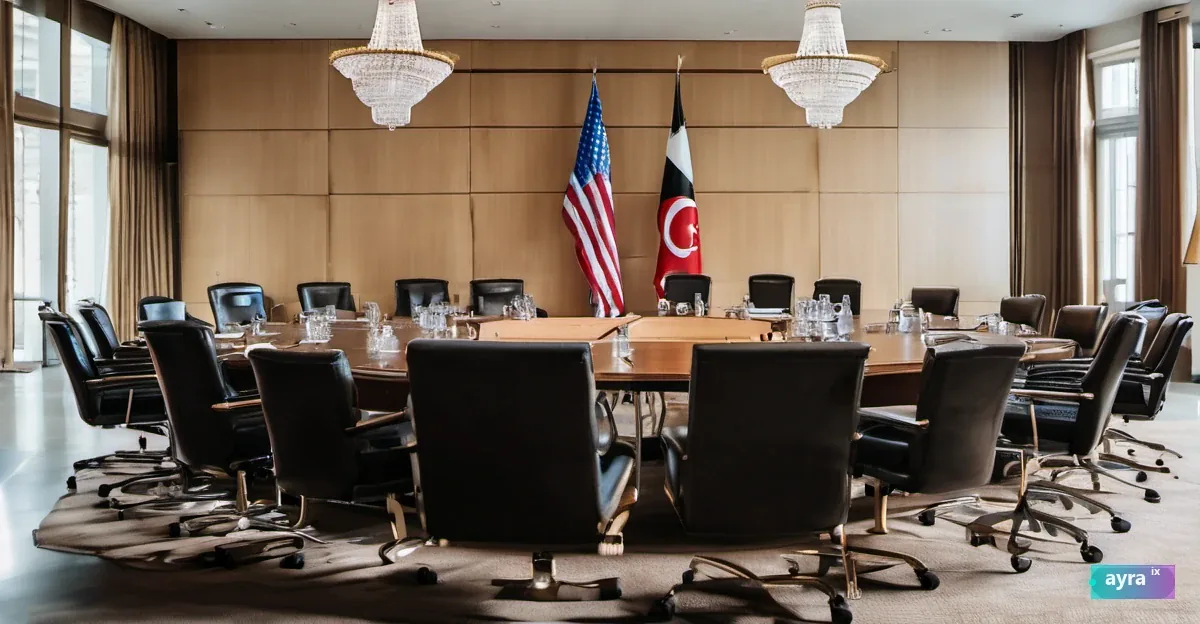
July 23, 2026 — Ankara. Air Force One touches down at Esenbo?a Airport under a hazy Anatolian sun. Donald Trump steps onto Turkish soil for the first time as a post-presidential statesman — except he's running again, and everyone in the room knows it. Recep Tayyip Erdogan waits on the tarmac. Volodymyr Zelenskyy's plane is two hours behind. By midnight, the leaders of thirty-two nations will be seated around a single table deciding the fate of the post-WWII alliance system.
This is the NATO summit that was supposed to be routine — a Seventy-fifth-anniversary gathering with some procedural updates and a communiqué about burden-sharing. Instead, it's become the most consequential diplomatic gathering since the end of the Cold War. Because the question nobody wanted to ask out loud is finally on the agenda: Is this the beginning of the end of the Ukraine war — or the beginning of the end of NATO?
The Ankara Calculus
Turkey's choice of venue was not accidental. Ankara sits at the geographic and ideological crossroads of every tension the alliance is trying to manage. Erdogan has spent the past five years playing Russia, the US, and Europe against each other with surgical precision. Now he's the host who controls the guest list.
Ukraine's membership path — the question that's been kicked down the road since 2008 — is no longer abstract. A ceasefire framework is on the table, drafted in back channels that involved Beijing and Riyadh as much as Washington and Brussels. The contours are clear: territorial concessions in exchange for security guarantees that stop short of Article V. It's a deal that satisfies nobody fully, which is exactly why it might actually hold.
The Post-American Question
Underneath the Ukraine negotiations runs a deeper current. The United States remains NATO's military backbone, but its political authority has been quietly eroding for a decade. European members have spent 2026 accelerating their own defense production lines — not because they want to leave NATO, but because they no longer trust that Washington's next president will honor the alliance's mutual-defense clause.
This is not a fringe position. Mainstream policy shops in Berlin, Paris, and London are running scenarios for a NATO-without-America. Not this year, not next — but the planning assumption has shifted from "unthinkable" to "prudent to prepare." The Ankara summit is the first where this contingency is discussed openly in the corridors.
Endgame Scenarios
Three outcomes are possible from Ankara, and they lead to very different futures:
- Frozen framework. A ceasefire with monitored boundaries, Ukraine gets bilateral security pacts but not NATO membership, Russia gets de facto control of occupied territories. Stability without resolution. This is the most likely outcome.
- Breakthrough. A full peace treaty with internationally recognized borders, major reconstruction commitments, and a neutral Ukraine with ironclad guarantees from multiple powers. Less likely, but the diplomatic machinery is real.
- Collapse. Talks break down, the alliance fractures publicly, and the war continues with renewed intensity. This is the nightmare scenario that keeps diplomats awake.
The market is already pricing in the first option. The question is whether the political leadership in Ankara this week can hold that line against the centrifugal forces pulling everyone apart.
What This Means for Everyone Else
The NATO summit's outcome will ripple far beyond Europe. Asian security architecture — QUAD, AUKUS, the simmering Taiwan strait — takes its cues from NATO's cohesion. If the alliance fractures, the Indo-Pacific order fractures too. If it holds, the message to Beijing and Pyongyang is unmistakable: the Western alliance system can adapt.
This is also a climate summit in disguise. The military-industrial implications of a protracted or resolved Ukraine war will shape carbon budgets for the next decade. European rearmament is not carbon-neutral. Every tank produced is a trade-off against the Paris targets — and the Ankara summit will determine which direction those trade-offs go.
What to watch in the coming days: not the official communiqué, but the bilateral meetings happening in the margins. Trump-Erdogan. Zelenskyy-Scholz. Macron-Starmer. The deal, if there is one, will be written in those rooms, not in the plenary hall.