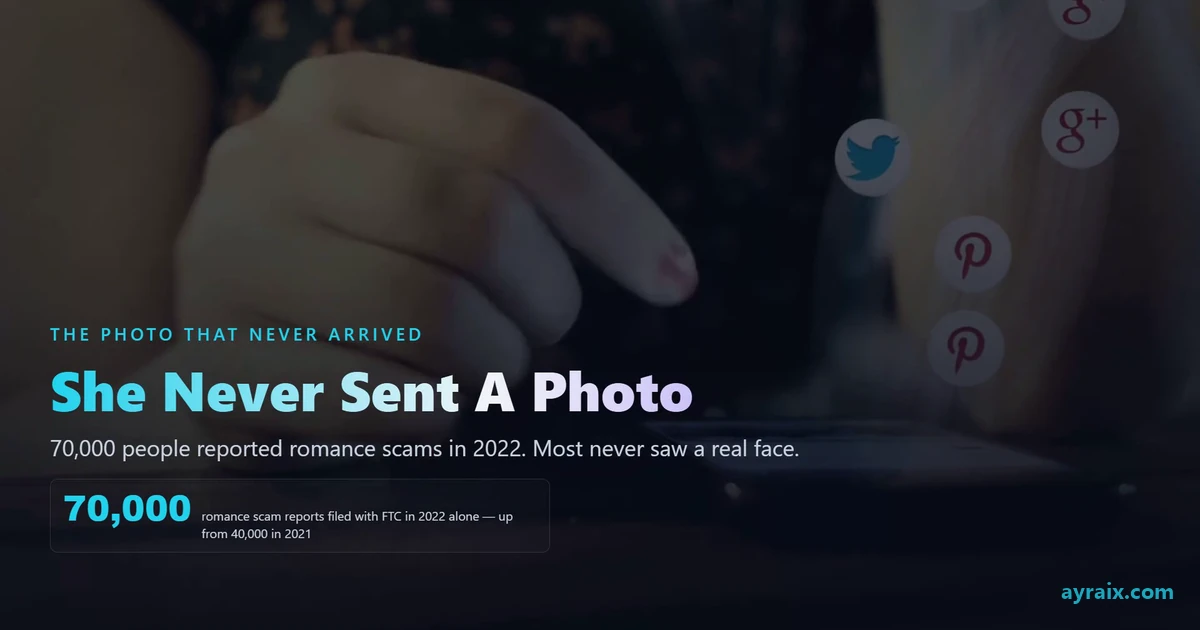
A question before we start. You talked for months. Maybe years. She said she was in the military, stationed overseas. She sent voice notes. She laughed at your jokes. But she never sent a photo. Not one real one. The one time you asked, she said she was shy. Or that her camera was broken. Or that she'd send one tomorrow.
Tomorrow never came. The photo never arrived. And by the time you understood why, you had already sent the money. How much? Five hundred? Five thousand? Fifty thousand? Pick a number. Now multiply it by forty-nine thousand people — that's how many Americans reported the same story in 2024 alone. The Federal Trade Commission counted $1.3 billion gone. A record. And the FTC says the reports are only the ones people admitted to. The real number is closer to ten times that.
Ask yourself, honestly: if someone you'd never met, never seen, never video-called — started messaging you tomorrow, and they were kind, and they were patient, and they remembered your dog's name — at what point would you start to believe them? After a week? After a month? After the first "I love you"? Be precise. The number you came up with is the number these operations are built on. They don't target the gullible. They target the human need for connection.
A record nobody wanted
Start with the number, because it's the one that should stop you. In 2024, Americans reported $1.3 billion lost to romance scams — a record, up 14% from the year before. The FTC's Consumer Sentinel Network logged nearly 49,000 reports in a single year. And those are just the people who filed. The FTC has said repeatedly that romance scams are among the most underreported frauds there are — victims don't report because they're ashamed. Experts put the true annual total as high as ten times the reported figure. That would put a real-world romance scam economy in the neighborhood of $13 billion a year. Just in America.
She never sent a photo
Here's what the FTC found when they asked how it happened: the answer, almost every time, was the same. The person on the other end didn't exist. Not a catfish using their own old photos. Something far more industrial. Stolen selfie collections. AI-generated faces that correspond to no human being on Earth. Deepfake video calls where the face moves and the mouth speaks, and the person behind it is three continents away reading a script.
The FBI warned about this in December 2024: artificial intelligence is now generating romance scam profiles at industrial scale — the faces, the voices, even the live video calls are synthetic. Then in February 2025, Meta removed more than 408,000 accounts tied to a single West African scam network. Four hundred eight thousand accounts, in one takedown, on one platform. And the networks simply pivoted. She never sent a photo — because there was no one to send one.
Where they find you
You didn't go looking for a scammer. The scammer came looking for you. Dating apps, Instagram DMs, Facebook comments, WhatsApp numbers, LinkedIn messages — any platform where a stranger can reach you is a hunting ground. The FTC's 2025 data shows that roughly 60% of romance scam losses start on social media — not email, not phone calls. The platform you check before you get out of bed.
They don't start with "send me money." They start with a compliment. A question about your profile photo. A shared interest. They're patient. They'll message for weeks, months — long enough to feel real. Long enough to become the person you tell about your day, your kids, your divorce, the things you don't say to anyone else. And then, only then, the emergency comes.
Crypto is the settlement layer
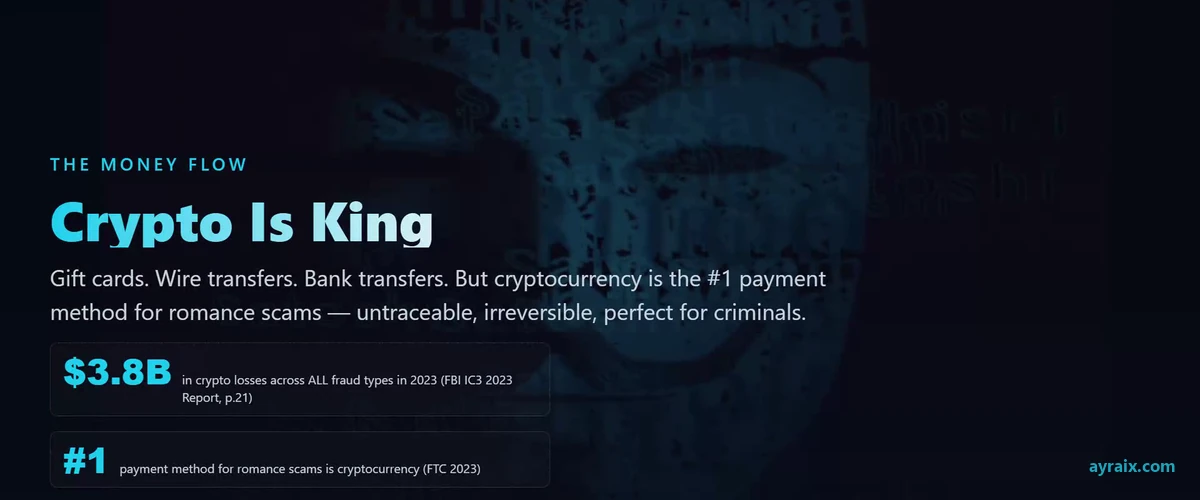
Gift cards. Wire transfers. Bank transfers. All of them work — all of them leave a trail. But cryptocurrency is king. Chainalysis tracked more than $14 billion moved to crypto scams in 2025 — and the numbers inside that report are the real story. The average payment per scam victim jumped 253%, from about $782 to nearly $2,764. Impersonation scams grew 1,400%. The people running these operations aren't fishing for pocket change anymore. They're running a balance sheet.
Here's the part you need to hear: The scammer doesn't need you to be greedy. They need you to be generous. "I need $500 for customs." "I need $2,000 for a medical emergency." "Invest with me — I'll show you how." The first ask is small. The second is bigger. The third is everything you have. Not because you're stupid — because once you've sent the first payment, it's no longer about the money. It's about the person. And you can't let go of the person.
Anne thought she was dating Brad Pitt
Meet Anne — a 53-year-old interior designer in La Réunion, a French island in the Indian Ocean. In early 2025 she received a message from "Brad Pitt." The actor, she was told, needed to reach her because his mother had blocked his accounts. AI-generated photos followed — selfies, "hospital" pictures, even supposed video messages. The fake Pitt needed money for a kidney treatment. Over the next year, Anne paid out €830,000 — roughly $855,000. Her entire divorce settlement, plus money she borrowed. She told her daughter the actor was paying her back in cash, hidden in a suitcase. When her daughter finally confronted her, she learned the truth — and went to the police. The Paris prosecutor's office opened a case against three men in their twenties, traced to Nigeria.
Anne survived three suicide attempts before dying by suicide in September 2025. French broadcaster TF1 pulled her interview from the air out of respect for her family. The real Brad Pitt's representatives called it "awful that scammers take advantage of fans' strong connection with celebrities." But here's the detail that should haunt you: the photos were generated. The videos were generated. The voice was generated. Every pixel of the person she loved was fiction — and it was enough to cost a woman her life savings and her life.
220,000 people in the compounds
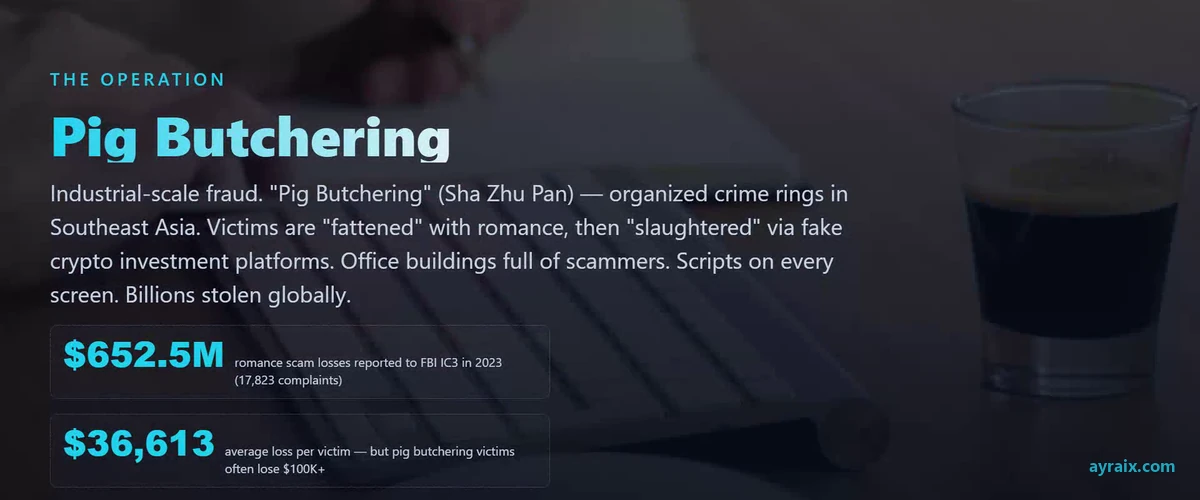
Now for the part that should make you furious. This isn't one person in a basement. "Pig butchering" — Sha Zhu Pan (杀猪盘) — is industrial. The United Nations estimates 120,000 people are being held in scam compounds in Myanmar and 100,000 in Cambodia — trafficked, locked inside, forced to run fake profiles at gunpoint. Some are scam workers. Many are victims themselves, sold between compounds like inventory.
The metaphor is where the name comes from. The victim is the pig. You fatten them with romance — weeks of sweet messages, shared plans, a relationship that feels more real than anything in years. Then you slaughter them: "I've been making money investing in crypto. Let me show you how." A fake investment platform. A wallet address. A first profit that actually comes back — the hook. Then a bigger deposit. Then everything.
The DOJ finally moved
Here's the part that changes the story. In May 2025, the U.S. Department of Justice announced its largest-ever action against the people behind these compounds: 146 targets — individuals and entities — across the scam ecosystem, with more than $15 billion in connected fraud losses identified. The Treasury sanctioned Chen Zhi, a Cambodian senator and the founder of Prince Group, one of Cambodia's largest conglomerates — the first time U.S. sanctions have named a sitting senator over scam compound involvement. The message: the people at the top of the pyramid, the ones whose companies host the compounds, are no longer untouchable.
It is real progress. And it is not nearly enough. For the victims, the recovery rate is still effectively zero. The apps still don't verify. The exchanges still don't flag. The banks still process the wires. One DOJ action, however big, doesn't change the economics of a $13 billion-a-year industry — it just raises the price of doing business. Which matters. But it is not the same as closing the door.
Not who you think
Here's the demographic that should make you sit down. Adults 60 and older lost $7.7 billion to fraud in 2025 — the most of any age group, and climbing every year. They're the easiest targets: often isolated, often living alone after a spouse's death, often with retirement savings sitting in accounts they barely check. But the FTC's data tells a different story when you look at romance scams alone: all ages fall for this. Twenty-somethings, forty-somethings, sixty-somethings. The scammer doesn't discriminate — and with the average payment up 253%, nobody is too small to be worth the script.
Why smart people fall
If you're still reading, and you're thinking I would never fall for that — you are exactly who they're looking for. Romance scams don't work by being obvious. They work by exploiting cognitive patterns that smart people are more susceptible to:
Love bombing: overwhelming affection early on. You've been lonely. Someone finally sees you. The rational part of your brain is saying "this is too fast" — but the emotional part is saying "I don't want it to stop."
Isolation: they'll gently discourage you from talking about them to friends and family. "They won't understand." "They'll judge us." Before you know it, the only person you talk to about the relationship is the relationship itself.
Urgency: there's always a deadline. Customs clearance. Medical emergency. An investment window that closes tomorrow. The urgency bypasses the part of your brain that would call a friend and say "does this feel right to you?"
The FTC identified the two most common lies. #1: "I'm in the military, stationed overseas." It explains why you can't meet. Why video calls are unreliable. Why payment apps don't work. #2: "I need money for an emergency." Medical, customs, travel — pick one. And now the technology means the photos check out, the videos check out, even the voice checks out. The lie has never been easier to tell.
The five questions
Here is the question gauntlet from the video, in writing, so you can keep it. Five questions nobody asks until it's too late:
1. Why has she never sent a photo — not one, not ever? Not a blurry one, not an old one. In months of talking, the closest thing to a face is a screenshot you were told not to share.
2. Why can't we video call — just once, for two minutes? The camera is always broken. The connection is always bad. The timing is always wrong. And now the technology exists to fake it anyway — so if it happens, it's not proof.
3. Why does every emergency involve money I can send right now? Customs. Surgery. A plane ticket. A lawyer. The emergency is always urgent, always expensive, and always payable in a form that can't be reversed.
4. Why do my friends and family keep saying they're worried? They're not jealous. They're not wrong. They're the only people in your life who aren't reading from a script.
5. Why does the story change every time I ask a hard question? The military base moved. The father got sick. The investment matured early. Write down what you're told. Read it back a month later. The holes will be visible even to you.
Every answer she gave was a script. The script was written for you — by people whose job is to write scripts for you. The money is gone. The wallet address is dark. The profile is deleted. And the only thing left that was real was the person who believed it.
South Korea acts. The US is starting to.
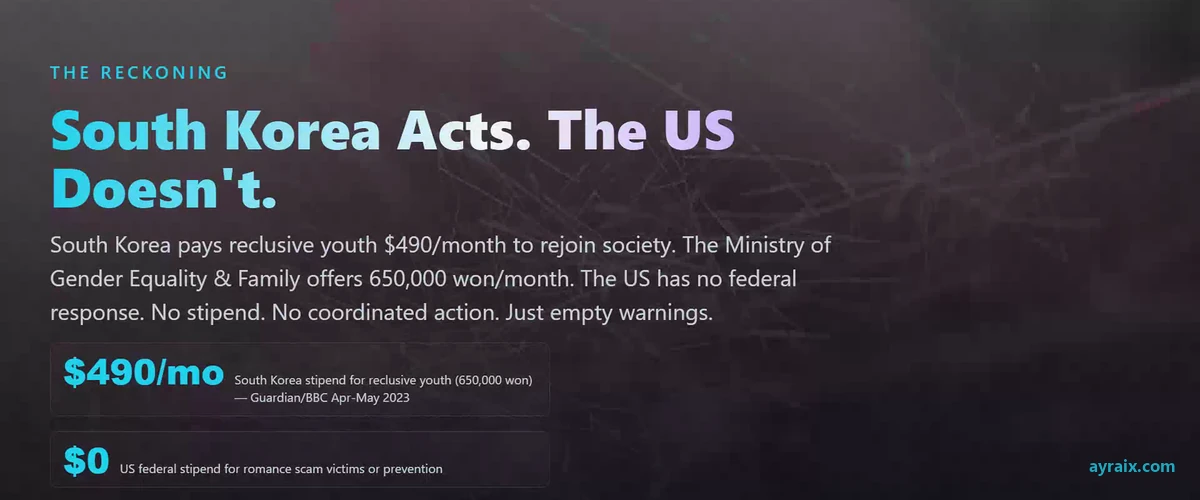
Here's the contrast. South Korea pays reclusive youth a monthly stipend to rejoin society — a government acknowledging that isolation is a public health crisis and funding it. The United States is finally moving on the supply side: the DOJ's May 2025 action, the Treasury sanctions, the $15 billion in losses identified. Real steps. But there is still no federal program for romance scam victims. No coordinated recovery. No liability for the apps that host fake profiles. The FTC publishes data spotlights. The banks process the wires. The exchanges process the transfers. And every single one of them says: "We can't be responsible for what our users do."
The argument
The door locks from the inside. But someone held it open.
Here's where this article takes a position, because the data demands it.
The romance scam epidemic is not a story about gullible victims. It's a story about a system built to let strangers into your life — with no verification, no accountability, and no liability for the platform that hosted the connection. Dating apps don't verify identity. Social media doesn't check if a photo is stolen. Crypto exchanges don't flag suspicious transfers. Banks process wires to known scam hubs because the instructions look legitimate.
Every link in the chain could have stopped it. None of them did. And the reason none of them did is the same reason every other public health crisis goes unaddressed: there is more money in not stopping it than in stopping it. Dating apps need new users. Social media needs engagement. Crypto needs volume. Banks need fees. The human cost is externalized — pushed onto the person who lost everything, who is then told you should have known better.
She never sent a photo. Forty-nine thousand people didn't notice. And the system that enabled it is counting on you to blame them, not it. The door locks from the inside. But someone held it open.
One last question, and then you can go. Who's responsible? The compound in Myanmar? The app that hosted them? The exchange that processed the crypto? The government that looked away? You, for believing? Or every single one of them — for a system designed to let this happen and a culture designed to shame the victim instead of naming the enablers?