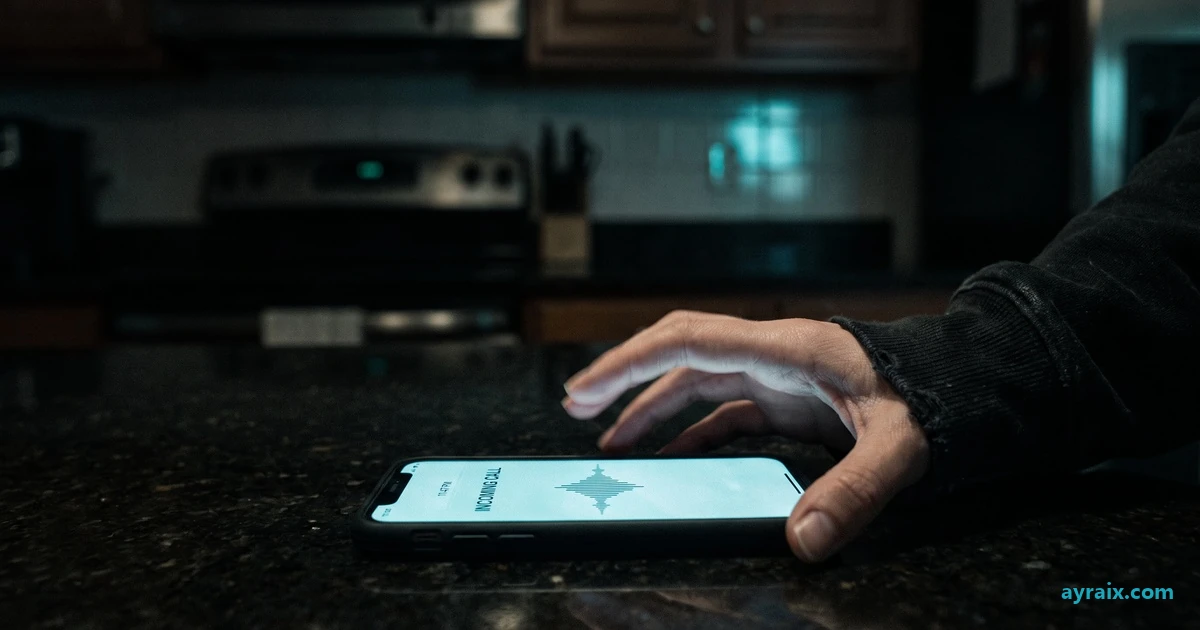
Composite — 11:47pm, a kitchen in Michigan. The phone lights up. The caller ID says it's your daughter's number, which is the first thing the scammers get right, because spoofing caller ID is free and takes one click. You answer. She's crying. She's slurring, terrified, panicking so hard she can barely get the words out — "Mom, please, I'm so sorry, I'm so scared, I love you" — and then a man's voice comes on the line and tells you your daughter is in his car, and that he will hurt her if you don't pay him right now.
Here's the part that should stop you cold: that was not your daughter's voice. It was a three-second sample of her voice, cloned by software that costs less than a pizza, and played back by a stranger who has never met her. The panic you feel is real. The person on the other end is not.
Ask yourself, honestly: if that call came at 11:47pm, with a voice you would recognize anywhere in the world crying your name — would you hang up and call your daughter's number, or would you start reading out your bank details? If you're not sure, this article is about you.
The call that broke a real family
In May 2026, a California mother named Jill Del Mastro took a call exactly like the one above — from what sounded like her daughter's number, in her daughter's voice, pleading and crying. For five hours, the caller kept her on the phone: she could hear her "daughter" sobbing, then a man demanding $10,000, threatening to hurt the girl if the call dropped. Del Mastro wired $5,400 before she finally hung up, called the real number, and got her daughter at work — confused, unharmed, and two thousand miles from any of it.
She told CNN the voice was "so, so real" — the crying, the intonation, the specific way her daughter said "I love you, Mom." A Florida grandmother, Sharon Brightwell, got the same call in July 2025: a crying "granddaughter," then a "police officer" demanding $15,000 in cash for bail — money she drove to a drop point and handed over. The granddaughter was at summer camp. The voice on the phone had been generated from a public video. The callers tell victims to keep the line open, to stay away from family and police, to move the money now — every step engineered to prevent the single action that kills the scam: a second phone call.
The FBI now has a category for this
Here's how fast this went from folklore to an official crime statistic: in April 2026, the FBI's Internet Crime Complaint Center (IC3) published its annual report for 2025 — and for the first time ever, it carved out "AI-driven fraud" as its own separate category, because it could no longer be filed under anything else. The numbers: 22,000+ complaints in a single year, and more than $893 million in reported losses — a figure the FBI stresses is almost certainly an undercount, because most victims never report it.
Run your eye over the more boring fraud statistics and you'll see why the FBI stopped pretending. Imposter scams — the family this belongs to — were the most reported fraud category in the US in 2025, with close to a million complaints filed. Losses to scams that started on social media hit $2.1 billion, roughly 8x what they were in 2020. And the FTC keeps repeating the same number in every warning: family emergency scams overwhelmingly target people aged 60 and over — people with retirement savings, a house, and an instinct that's been trained since before the internet existed: when family is in danger, you do not negotiate, you act.
Three seconds
So how hard is it to clone a voice? The number that keeps coming out of every investigation — the FBI's, the FTC's, and Consumer Reports' own testing — is three seconds. That's how much audio the modern cloning services say they need to produce a convincing replica of a specific person's voice. Your daughter's TikTok, her Instagram story, a voicemail greeting she recorded when she was fourteen, a family video she was in — any of it is enough. Nobody has to kidnap anyone to get the sample. You posted the weapon yourself.
Consumer Reports ran the test in 2025-2026 and the findings were blunt: the tools have grown stunningly good, and the abuse-prevention baked into them is thin. ElevenLabs — the best-known player, which does advertise voice-protection features — told Consumer Reports it maintains "multi-layered" security, but the testers' experience of uploading someone else's audio and getting a working clone in under a minute didn't exactly back up the marketing. The business model is the problem: voice cloning is sold as a mass-market consumer product, priced at a few dollars a month, with volume pricing that makes a scam operation's overhead effectively zero. When a tool is sold this cheap and this openly, the question isn't whether criminals will weaponize it. The question is why the pipeline exists at all.
Your ears are useless now
Here's the part that's harder to accept than any statistic: your ears cannot tell the difference anymore. In a 2025 study at UC Berkeley, researchers played over 600 people real voices and AI-cloned voices side by side — voice lines that included crying, panicking, and begging, the exact emotional register scammers need. Listeners misidentified the AI voices more than 80% of the time. Not "sometimes." Not "when the audio was bad." More than four out of five, on emotional speech, the specific attack this scam is built around.
Think about what that actually means: the sound of your child crying was the last unbreakable guarantee in your life — the one thing no stranger could fake, no recording could reproduce, no scammer could impersonate. It's gone. That guarantee has been replaced by a monthly subscription. Your mother's ear was the final line of defense in a thousand family emergencies, and the industry that sells the cloning software has quietly retired it.
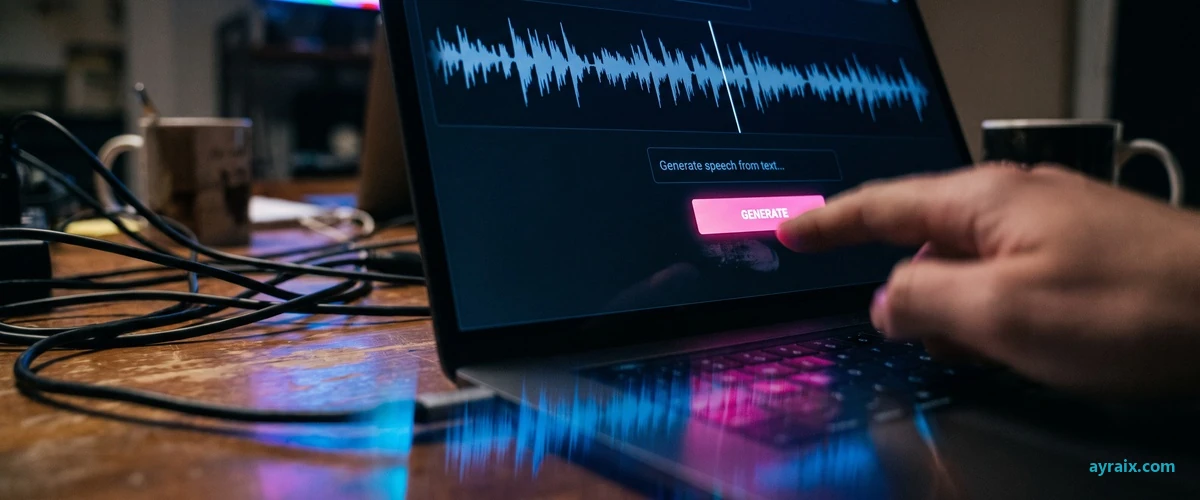
And the technology keeps moving. Voice cloning apps now routinely add real-time voice changing — you can feed them a script and get a fully-intoned, emotionally-acted line in the target's voice in seconds. There is no observable difference you can train your ear for. The best-trained humans on earth, in the best conditions, with the audio side-by-side, are wrong more than 80% of the time. At 11:47pm, on a crying voice, through a cheap phone speaker, you will not beat the odds. You don't beat this scam with your ears. You beat it with your habits.
It's never one family
Sharon Brightwell's story has a cousin. In May 2026, Kris Sampson of Missoula, Montana, got a call from what sounded like his own son — and it nearly emptied him. He was on a plane, mid-trip, when the voice on the line said it was his son, that everything was going wrong, that money needed to move now. Sampson told CNBC he was seconds from wiring his account when the pattern nagged at him: the son he could hear on the phone was unreachable, while the son he could reach was silent. He hung up, called the real number, and got his son at work. The voice had been cloned. The flight didn't matter. The panic had a boarding pass.
And in South Korea, where this crime wave hit years earlier, the response is worth reading twice: the phone companies built detection into the network itself — carriers flagging calls that show the hallmarks of AI-generated voices, after cloned voices emptied entire life savings in a matter of months. The Korean approach is a quiet admission from the industry: the human ear already lost, so the machines had to catch the machines. That technology exists. It is being deployed on the other side of the Pacific Ocean. American carriers — the same ones billing you for the calls — have not adopted anything comparable, and your mother's phone still rings with a voice it cannot verify.
Think about that for a second: a country decided this was a network problem — the way you harden a bridge against collapse — and built the fix into the infrastructure. Here, the same problem is still filed under "consumer education," which means the same people who sold the weapon, and the carriers who profit from the calls, are asking your grandmother to be smarter. Korea didn't ask victims to be smarter. Korea asked the network to stop lying.
It's an industry now
If you're picturing a basement, update the picture. More than three-quarters of all cybercrime is now scams and social engineering — people being manipulated, not systems being hacked — according to financial-crime experts like Patrick Bednowitz, who testified to Congress that the criminal landscape is now dominated by industrialized call centers. Adam West, who spent 26 years at the FBI's Operation Shamrock working financial crimes, told a US Senate committee in 2025 that it's now a "scamdemic": a crime wave too big for the agencies to dent, where victims are profiled by age and savings, and scripts are A/B tested like marketing copy.
Then there's the future that's already here: in early 2026, researchers at Rutgers built an autonomous end-to-end AI scam-call system — a bot that recruits a victim, opens the conversation, and runs the whole con start to finish, with no human in the loop — as a demonstration of what the next wave looks like. They built it precisely because existing defenses are reactive and human. The demo worked. The calls it makes are entirely automated, operate at scale, and cannot be tired out, guilted, or reasoned with. A scam that used to require a person with a script, a fake accent, and a headset now requires a server, some stolen voice samples, and a phone plan.

The victim-blaming trap
Here's where the coverage of this story goes wrong, and it's worth saying plainly: "should've had a code word" is not a defense. It's victim-blaming with a family-security checklist. Every expert's recommendation — a family code word, verify with a second call, never wire money — is genuinely good advice. And every one of them fails in the exact moment they're meant to protect, because the scam is not an information problem, it's a panic problem. At 11:47pm, hearing your granddaughter sobbing, no checklist in your head is running. The code word doesn't fail because people are careless. It fails because the attack is engineered to fire the one cognitive system that bypasses all checklists: terror about a child.
And make no mistake about who gets blamed. The scammers are unreachable — foreign call centers, disposable numbers, cryptocurrency, money mules — while the victims are here, in our families, embarrassed, ashamed, and often too humiliated to tell anyone, which is exactly why the FBI says its $893 million is an undercount. The grandma who hands over her savings gets the "how could you" from her own children while the guy who sold the tool gets a term sheet. That's the accountability inversion at the heart of this story, and the industry is counting on it.
Here's the uncomfortable question: when a cloned voice empties a grandparent's account, who is responsible — the scammer, the tool company that sold the cloning software for $12 a month with no effective safeguards, the platform that hosted the voice sample the tool was trained on, or the family for not being "smarter"? If you blame the family, you're doing the tool company's PR for them.
Who actually gets blamed
Follow the accountability and the picture gets uncomfortable fast. The voice-cloning companies sell a tool that their own testers confirm can be used to clone any stranger's voice in under a minute, with safeguards Consumer Reports found ineffective — and their position is, essentially, that they're a neutral technology. The platforms host the TikTok videos and Instagram stories that supply the training audio, and they're the same platforms that also surface ads for "instant voice cloning" apps to the very people who'll be scammed. The banks process the wires and the Zelle transfers, and when the money moves fast enough, it's gone before any fraud team can act — with liability rules that largely leave the victim holding the bag on "authorized" transfers. And the scammers themselves? They're in jurisdictions with no extradition, running the same playbooks that have worked for a decade, now with better tools.
The regulators are waking up — the FTC's fraud warning pushes code words; the FCC moved in 2025-2026 to let carriers block robocall traffic; the FBI keeps adding categories — but the entire response so far is reactive, post-hoc, and aimed at the victim's behavior rather than the weapon's availability. Nobody has yet made the sale of unguarded voice-cloning tools to the public meaningfully illegal anywhere. The FTC's own guidance for consumers, read carefully, is a confession: the only reliable defense is a family protocol established before the call comes. The government says the fix lives in your kitchen, not in their statutes. Which is... a choice.
The one defense that actually works
So here's what does survive contact with a 3am panic — and it's shorter than you think:
Have the conversation once, now, at a kitchen table. Pick a family code word — something nobody would guess and nothing online knows — and tell your parents and your kids it exists. But design it the way the scam is designed: the code word is not for the panicking caller to pass. It's for the panicking parent to demand. The script is: the moment someone on the phone claims your child is in danger, you don't argue, you don't threaten — you say the code word, or hang up and call the child's real number, on the child's real device, on your own dial. That's the entire defense: you never trust the incoming call, and you never pay anyone who demands you stay on the line. The "stay on the line" demand is the scam's tell, every time — a genuine emergency doesn't need you to stop communicating.
And know the second call is the whole game. Every victim story that ended well ended the same way: someone hung up and called the real number. Del Mastro's story ends with her daughter safe at work. Brightwell's ends with a granddaughter at summer camp. The scam's entire architecture exists to prevent that second call — so train for the second call. Hang up. Redial. A voice you recognize isn't proof. Reaching the person is.
What to watch: whether the FTC's and FCC's warnings turn into actual regulation of voice-cloning tools — whether "no effective safeguards" becomes legally indefensible in 2026-2027, or stays a Consumer Reports finding that nobody in Washington acts on; and whether the banks, who can see a suddenly-emptied senior account in real time, adopt the mandatory-fraud-review standards consumer advocates have been asking for. The tech is not going backwards. Only the accountability can go forward.
One last thing to sit with. The scammers didn't break in with a bug, and they didn't hack a bank. They walked in wearing your daughter's voice. The only defense that remains is each other — a code word agreed at a kitchen table, a rule that money never moves from an incoming call, and the discipline of a second phone call. The industry is betting you never have that conversation in time. Talk tonight. Not tomorrow.