
SAP's AI Offer to ECC Customers Has a Condition: Half Your Maintenance Spend
As reported in May: on-premises customers get Joule assistants only after moving 50% of maintenance spend to the cloud. What it means and what to check.
SAP wants every customer using AI. SAP also wants every customer in the cloud.
At Sapphire in May, those two goals met in a single condition. And if you run ECC, it is worth knowing exactly what it says, because it quietly defines the price of admission to SAP's AI.
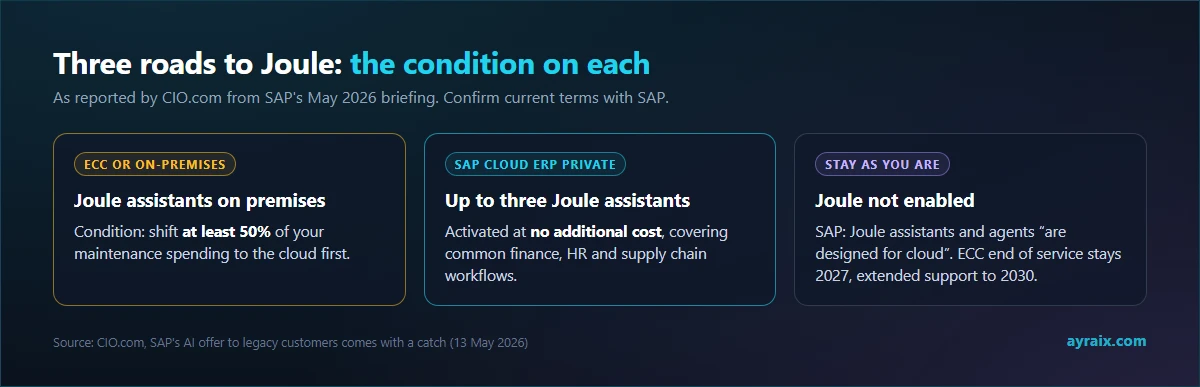
The short version: to switch on Joule assistants on premises, customers must first shift at least half their maintenance spending to the cloud. Customers already on SAP Cloud ERP Private get up to three assistants at no extra cost. Everyone else waits.
A caution before we start. These are the terms as reported by CIO.com on 13 May 2026. I did not find a change since SAP Connect in October, but please confirm the current terms with your SAP contact before you plan around them.
The offer, line by line
CIO.com reported that customers still running SAP software on-premises can enable Joule assistants, but only after moving at least 50% of their maintenance spending to the cloud. SAP's chief strategy officer confirmed the offer at a media briefing, and an SAP spokesperson confirmed the 50% requirement.
For customers already on SAP Cloud ERP Private, the deal is sweeter: SAP will activate up to three Joule assistants at no additional cost, across common finance, HR and supply chain workflows.
SAP was open about the logic. Its chief strategy officer said Joule assistants and agents "are designed for cloud" and that "destiny is unchanged". The offer is about meeting customers where they are, not changing where they end up. An SAP spokesperson also said there are no plans to extend the ECC end-of-service date beyond 2027, with extended support through 2030 at additional cost.
Is it fair?
There are two honest views.
View one: it is reasonable. An analyst quoted by CIO.com said it is very hard for any software vendor to offer AI on an on-premises platform that was not designed for it. That is true. Agents need stable interfaces, clean data and consistent processes. A heavily customised ECC landscape often has none of those.
View two: it is a nudge. The CIO piece quotes a partner CEO who says more than 20,000 customers are stuck on ECC because of custom code and customization. Another consultant estimated that as many as 40% of SAP customers could still be on ECC in 2030. Both are estimates, and the partner sells agents that run on ECC without migration, so treat their claims as one vendor's view.
IDC, as quoted by CIO.com, adds a reality check on cloud moves: 31% of organizations are moving from on-premises to cloud, and 23% are moving back.
Here is what customers are actually doing with AI
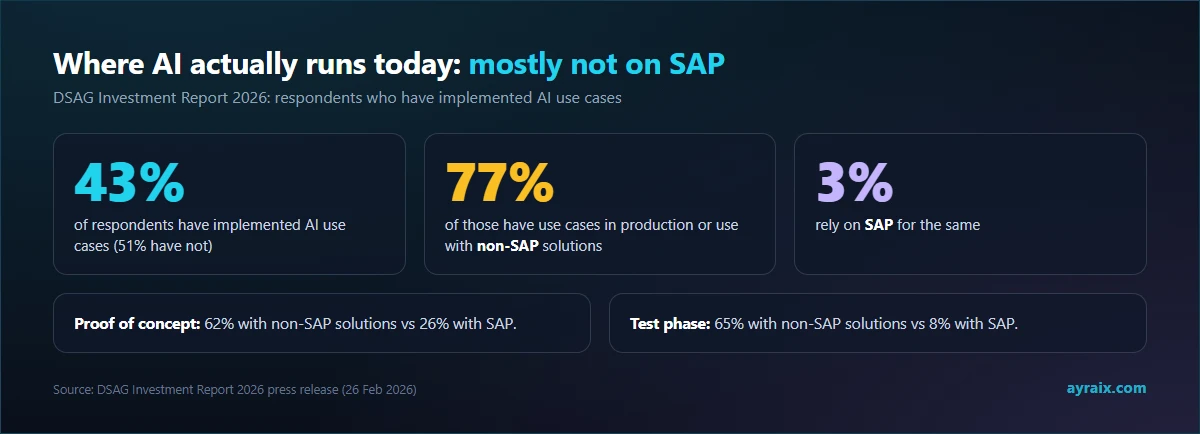
This is the number that makes the condition interesting. DSAG's 2026 survey asked members about AI use cases.
- 43% say they have already implemented AI use cases. 51% have not.
- Of those, 77% have use cases in production or in use with non-SAP solutions. Only 3% rely on SAP for this.
- In proof-of-concept: 62% with non-SAP solutions versus 26% with SAP.
- In the test phase: 65% with non-SAP solutions versus 8% with SAP.
DSAG's reading: non-SAP tools often give faster access today, and there is reluctance around SAP-based AI, partly because of complex licensing and mixed landscapes. DSAG asked SAP for "more freedom of choice, transparency, and realistic migration paths".
So SAP's AI is currently the minority path. A condition that gates it behind a cloud commitment makes that path narrower still.
A simple way to think about the decision
Here is an illustration, not SAP's numbers. Say your annual SAP maintenance bill is 1.0 million. Under the 50% rule, you would need to move 0.5 million of that spend to the cloud before Joule is enabled on premises. The real question is what that move buys you, and what it commits you to.
The CIO report does not spell out what "moving maintenance spend to the cloud" means in contract terms. That is the first thing to ask SAP.
Then compare three roads:
- Take the offer. You get Joule on premises. You commit spend to the cloud. Good if your migration was coming anyway and you want AI value sooner.
- Use AI outside SAP for now. Extract governed data and use external tools, which is what most DSAG respondents already do. Good for narrow use cases. You carry the integration and security work. Some vendors also sell agents that run natively on ECC. Test those claims on your own landscape.
- Wait. Spend nothing on AI until the migration is done. Safe, but you give up learning time.
My read: the right road depends on whether your blocker is access to AI or readiness for AI. If your processes and data are messy, a switch that turns on assistants will not fix that. It will show it.
Questions to ask before you say yes
- What exactly counts toward the 50%? Which contracts, which products, over what period?
- Which assistants do I get on day one, for which processes, and on which release and landscape?
- Is the cloud commitment reversible? What does it cost to undo?
- Do I need SAP's AI, or only SAP's data? Those are different needs. A model outside SAP can work on governed data you extract.
- What does usage cost? See our AI Units post on consumption.
A readiness scorecard before you buy AI for ECC
This is my own framework, not SAP's. Answer yes or no:
- Do you know your custom code inventory, and which of it is actually used?
- Can the business data an assistant needs be reached through stable, documented interfaces?
- Are your roles clean enough that an assistant inheriting them would not worry you?
- Is your master data something people trust?
- Are your processes standard enough for an assistant to follow, not guess?
- Can you log and review what an assistant does?
If you answer "no" to more than two, the AI will mostly show you what to fix first. That is useful, but it is not the productivity story in the brochure.
A reality check on the "free" assistants
For Cloud ERP Private customers, the offer reads well. But look at the status in SAP's own Connect guide. SAP says managed integration with Joule for Cloud ERP Private is "currently available through the SAP Early Adopter Care program, with general availability planned for Q4 2026". The integration is delivered and maintained by SAP as part of the Cloud ERP Private subscription, with an opt-in in SAP for Me.
So the answer to "can I have it now?" may depend on programs and timing. Ask what your eligibility is, in writing.
How to test an "AI on ECC without migration" claim
Some vendors say their agents run natively on ECC. Maybe they do. Here is how to find out:
- Ask for a reference customer on your release and add-ons.
- Ask which interfaces it uses to read and write, and what data leaves your landscape.
- Ask what happens at migration. Does the work carry over, or is it thrown away?
- Ask how it fits your SAP licence terms.
- Run a 30-day pilot on one process with a baseline you measured before the pilot.
The take
It is a fair business move. It is also a migration deadline wearing an AI badge.
If the AI value is real for you, 50% may be a fair price. If it is not yet, you have just learned what finding out will cost. Either way, do the arithmetic before the demo, not after it.
Sources
- CIO.com: SAP's AI offer to legacy customers comes with a catch (13 May 2026)
- DSAG Investment Report 2026 press release (26 Feb 2026)