
Everyone Talks About 2027. SAP Just Told Customers the Date That Really Bites Is 2030.
SAP's 7 October post on 2030 changes the ECC conversation: third-party database and Java support end, and conversions close. Plus the DSAG numbers.
Ask ten ECC customers about their deadline and nine will say 2027.
On 7 October, SAP's CTO published a post that suggests the date to watch may be 2030. Not because the maintenance dates changed. SAP says they have not. But because of what quietly stops working at the end of 2030.
And today, 13 October, SAP updated another page that stretches a different date out to 2035.
If you run Business Suite 7, especially on a third-party database, read on. This changes how you should plan.
The short version: 2027 is mostly a commercial date. 2030 is a technical one. After 2030, the path to convert a system on a third-party database closes, and SAP stops supporting that database and Java in the way it does today.
The dates that did not change
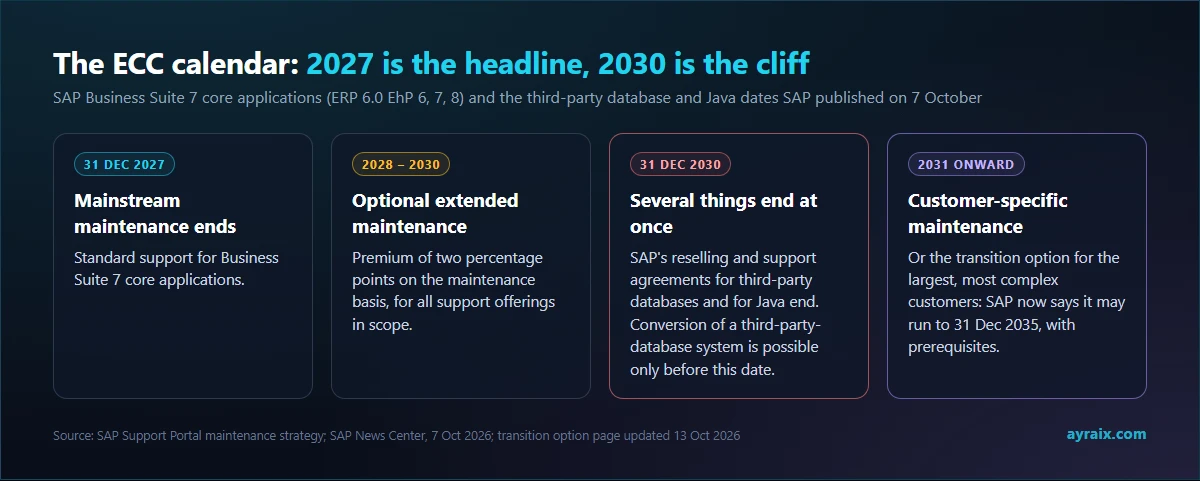
SAP's published strategy for Business Suite 7 core applications (ERP 6.0 with enhancement packages 6, 7 and 8) is:
- Mainstream maintenance until 31 December 2027.
- Optional extended maintenance from 2028 to 31 December 2030, for a premium of two percentage points on the maintenance basis for all support offerings in scope.
- Customer-specific maintenance afterwards.
SAP's CTO repeated on 7 October that these dates "have not changed". CIO.com reported in May that an SAP spokesperson said there are no plans to extend the 2027 end of service.
What SAP added on 7 October
Here is the part many people will miss. At the end of extended maintenance, several support arrangements expire at the same time:
- SAP's reselling and support agreements with major third-party database providers, for these legacy environments.
- SAP's support arrangements for Java (Java 8 / JEE5) used with SAP NetWeaver AS Java 7.5.
What does that mean in practice? Today, if you raise a ticket about a third-party database problem, SAP handles it end to end and routes it to the database vendor. SAP says that integrated path will no longer exist after 2030.
Under customer-specific maintenance in 2031 and later, SAP says it will not be able to provide comprehensive support for third-party database or Java issues. That includes kernel patches and kernel security patches for third-party database environments. SAP may also no longer be able to provide support, and even downloads, for database tooling: administration, backup, upgrade and migration tools.
SAP NetWeaver AS Java 7.5 with all add-ons moves into customer-specific maintenance in 2031 "without a follow-on release".
The line that should stop you
SAP says a system conversion from Business Suite 7 on a third-party database to S/4HANA or SAP Cloud ERP will only be available before the end of the reseller and support agreements at the end of 2030. After that point, "only greenfield transition scenarios (new implementations) will be possible."
Read that again. It is not "support gets worse". It is "one of the migration paths closes".
If you were planning a conversion in 2031 or 2032, because 2030 felt far away, that plan has an expiry date. Check it with SAP in writing for your exact database and release.
And the other date: 2035
For the largest and most complex customers, SAP offers the transition option for SAP ERP, a time-bound subscription for business continuity. When SAP described it in 2025, it covered 2031 to 2033. A note added to that page dated 13 October 2026 says subscriptions may now run until 31 December 2035, with further prerequisites.
Do not read this as "ECC is safe until 2035". The prerequisites, from SAP's 2025 description, are serious:
- Systems must move to SAP ERP, private edition on SAP HANA before 31 December 2030.
- SAP HANA is the only supported database.
- A minimum system size of 2 TB.
- Technical readiness, including mitigation for products the option does not cover.
- The max success plan, bought alongside it.
- It is priced at an uplift. In 2025 SAP said customers signing up in 2026 would see a standard 20% uplift when switching to the option in 2031.
- It does not support Java-dependent capabilities.
Pricing and terms may have changed since 2025. Check the current SAP Support Portal page and SAP Note 3591251.
The honest summary: it is a bridge for a small group of very large landscapes. It is not an escape hatch for everyone.
What customers say they will do
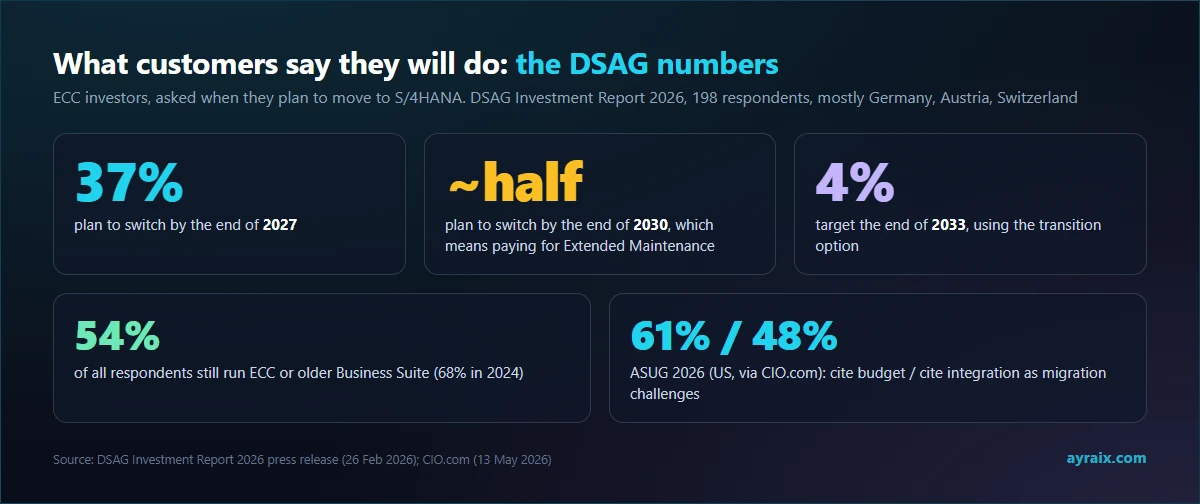
DSAG, the German-speaking SAP user group, published its Investment Report 2026 in February. It asked ECC investors when they plan to move to S/4HANA:
- 37% by the end of 2027
- Almost half by the end of 2030, which means paying for Extended Maintenance
- 4% by the end of 2033, using the transition option
A careful note, because this number travels badly. You will see "only 37% of ECC companies will make it". DSAG measured something narrower: the 37% are among respondents who plan to invest in ECC. The survey is small too: 198 people, mostly in Germany, Austria and Switzerland, one per company.
The wider trend is clear, though. In the same report 54% of respondents still run ECC or the older Business Suite (68% in 2024), while S/4HANA on-premises is at 56%.
Why the delay? In the US, the ASUG 2026 survey, as reported by CIO.com, found S/4HANA migration is still the biggest challenge: 61% cite budget and 48% cite integration. DSAG's top influences on SAP investment: cost-effectiveness (79%), economic conditions (79%), licence and contract design (70%) and end of maintenance (63%).
Notice what comes first. Not features. Not AI. Cost.
What I would do with this
- Inventory your dependencies. Which systems run on a third-party database? Which use AS Java 7.5? Put them in a table, with owners.
- Decide conversion or greenfield, with a date. If conversion is the plan, find out the latest realistic start for each system. It is earlier than 2030.
- Do not treat 2027 as the finish line. It is when your support terms change, and extended maintenance has a price. Put the two-point premium in the budget.
- Do not treat moving to HANA as a plan. SAP says switching to HANA before 2030 removes the database dependency, but it does not extend maintenance and SAP does not recommend it as the strategic path.
- Ask about the transition option only if you are large and complex. And read the prerequisites before you hope.
- Talk to your user group. A DSAG board member welcomed SAP's early information but stressed that decisions should rest on a full assessment of alternatives.
A rough budget model (an illustration)
Extended maintenance adds two percentage points to your maintenance basis for the scope in question. A simple way to size it:
Extra cost per year = 2% x your maintenance basis. Over the full three years (2028 to 2030) = 6% x the basis.
Illustration only: if your maintenance basis were 10 million, the premium would be about 200,000 a year, or about 600,000 across three years, on top of what you already pay. Use your own contract figures. The point is that the premium is knowable and small compared with a stalled migration, so it should be a line in the budget, not a surprise.
Which landscape are you?
- Business Suite 7 on SAP HANA, ABAP only. Your key date is the end of 2027, and the question is cost and plan. The third-party database cliff does not apply to you.
- Business Suite 7 on a third-party database. Your key date is the end of 2030 for conversion, and the real work is deciding conversion versus greenfield with enough time to execute.
- Components on SAP NetWeaver AS Java 7.5. SAP says they move into customer-specific maintenance in 2031 with no follow-on release. Read the product-specific transition guidance in SAP Note 3464370.
- Very large and complex. Look at the transition option, and read its prerequisites first.
SAP Notes to read this week
SAP's 7 October post points to these. They are the primary sources, and they are more precise than any blog.
- 1648480: maintenance for SAP Business Suite 7 software including SAP NetWeaver.
- 3464370: SAP NetWeaver AS Java end of maintenance, proposed transitions.
- 3591251: product coverage for the transition option.
- 3832186: third-party database maintenance, limitations in customer-specific maintenance.
- 3768400: end of extended maintenance by end of 2030 for SAP BW NetWeaver Cloud.
The take
The 2027 date fills conference slides. The 2030 date fills incident reports.
If your landscape is simple, none of this scares you. If it is old, big and database-heavy, the calendar just got more specific. Better to learn that on a Tuesday in October than in a steering committee in 2029.
Sources
- SAP News Center (CTO): Planning Beyond 2030 (7 Oct 2026)
- SAP Support Portal: maintenance strategy for SAP S/4HANA and Business Suite 7
- SAP News Center: Updates for SAP ERP, private edition, transition option (updated 13 Oct 2026)
- DSAG Investment Report 2026 press release (26 Feb 2026)
- CIO.com: SAP's AI offer to legacy customers comes with a catch (13 May 2026)