SAP Wants AI Agents to Fix Your Custom Code. We Find Out How on 27 October.
SAP TechEd Berlin starts 27 October with sessions on agent-led custom code migration. What SAP announced, the clean core levels, and what to ask in the room.
Every ECC migration has the same villain. Not the budget. Not the database. The custom code.
Thousands of Z programs, user exits, forms and reports. Written over twenty years. Understood by three people, two of whom have left.
SAP now says AI agents can take that on. The proof is due at SAP TechEd Berlin, 27 to 29 October. The virtual edition is free.
This is a preview. I have not seen the sessions. What I can do is show you what SAP has put on the agenda, explain the framework behind it, and give you the questions that separate a good demo from a good result.
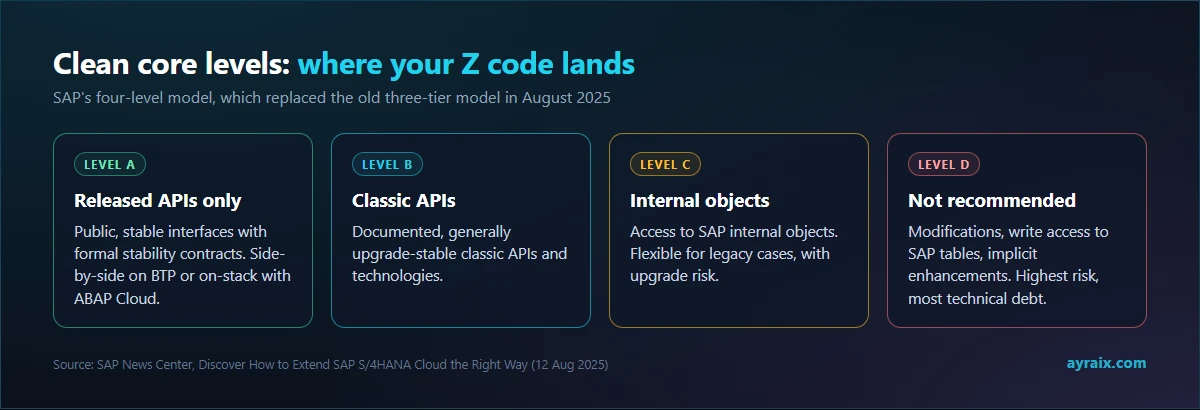
The short version: SAP says an agent-led toolchain will take custom code from planning to "mass remediation". Whether that works depends on one number: how many of the agent's fixes survive review and testing untouched.
What SAP has put on the agenda
From SAP's own TechEd 2026 ABAP session overview:
- TM105, Agent-led custom code migration: from planning to mass adaptation. SAP's text says custom code migration often bottlenecks the move from SAP ERP Central Component to SAP Cloud ERP Private. The toolchain runs from planning in SAP Cloud ALM to "AI-powered mass remediation" with the Custom Code Migration Agent in SAP Joule for Developers. Sessions on 27 and 29 October.
- TM260, hands-on workshop: migrate and modernize custom code from ECC to RISE with agentic AI, using MCP tools.
- TM103, reimagining migration and modernization with agent-led AI assistants. SAP's words: assistants that cut costs, speed up timelines and span the full migration lifecycle.
- TM108, the clean core journey for SAP Cloud ERP Private, including how AI helps make custom code clean core compliant, and new guidance tied to SAP's API policy.
- AD100 and AD819, agent-led ABAP development, built on the ABAP Language Server and the ABAP MCP Server. SAP's headline for the whole track: development moves from "AI-assisted" to "agent-led".
First, the framework: clean core levels
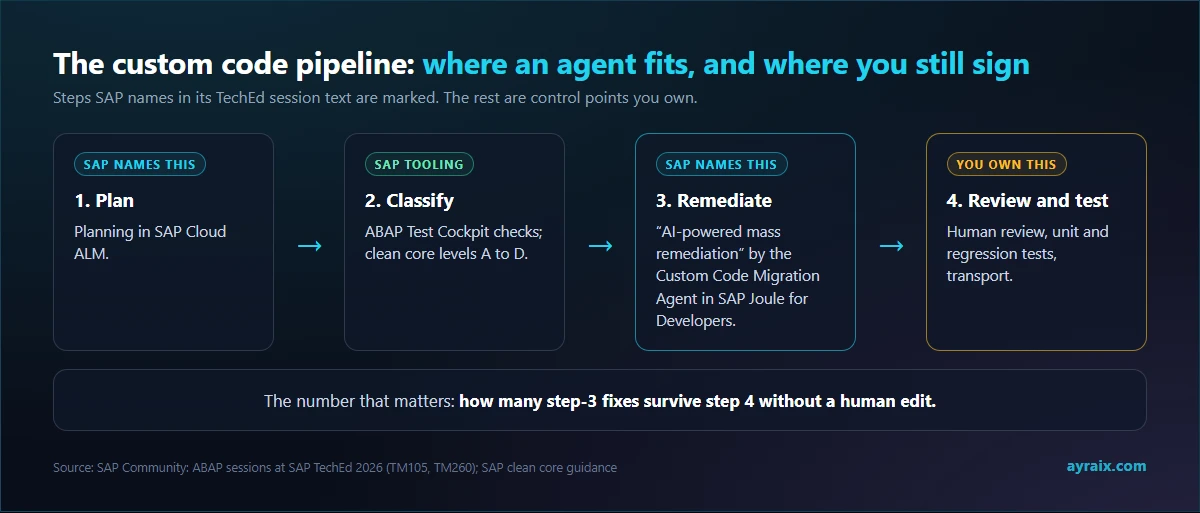
To judge any agent, you need to know what "fixed" means. SAP defines it with clean core levels, introduced in August 2025 to replace the old three-tier model.
- Level A: uses only publicly released, stable interfaces, backed by formal stability contracts. Built side-by-side on BTP or on-stack with ABAP Cloud.
- Level B: also uses SAP's classic APIs and technologies, which are documented and generally upgrade-stable.
- Level C: accesses SAP internal objects. Flexible for legacy scenarios, but with upgrade risk. SAP plans a changelog for SAP objects to help spot changes early.
- Level D: not recommended. Modifications, write access to SAP tables, implicit enhancements. SAP calls these the highest risk and a source of significant technical debt.
Here is something I find telling. SAP's own community guidance says the old binary view, "clean core" versus "not clean", was "too restrictive" for systems with a lot of classic custom code. In other words, SAP changed the model because real landscapes could not meet the old one.
For governance, SAP recommends the ABAP Test Cockpit, and says central ATC on SAP BTP is its recommended approach for governing clean core development in private cloud and on-premises landscapes.
Why this matters beyond the conference
Custom code is one of the main reasons customers give for being late. A partner CEO told CIO.com that many customers are "stuck on ECC due to Z codes and industry customizations". DSAG's chairman points to complex landscapes and skills shortages.
And remember the calendar. SAP says mainstream maintenance for ECC ends in 2027 and extended maintenance in 2030. If agents can safely cut the custom code effort, the migration math changes. That "if" is the whole story.
What an agent can do well, and where it gets risky
My read, not SAP's: some custom code work is a good fit for machines.
- Good fit: repetitive, rule-driven changes. Replacing obsolete statements or calls, adapting to a known simplified data model, mass fixes of the same pattern across hundreds of objects.
- Risky: code whose intent lives in somebody's head. A user exit that quietly fixes a business rule. A report with side effects. Anything where "compiles and passes ATC" is not the same as "still does what the business needs".
An agent that clears a technical check can still break a business outcome. That is why the review and test step matters as much as the remediation step.
Questions to ask in the room
- What share of fixes needs no human edit? Ask for the number, and the size and kind of the sample behind it. A demo on tidy code proves little.
- How is a change reviewed, tested and transported? Does the agent propose, or does it write straight into a development system?
- What happens to code that cannot reach level A or B? Rewrite, retire, or keep outside the core?
- How does it behave on my release and add-ons? The session text talks about Cloud ERP Private as the target. Ask about S/4HANA on-premises too.
- What does mass remediation cost to run? Ask about any consumption charges and who pays for failed attempts.
- Who is accountable when an agent-made change causes an incident? You will need that answer in writing.
A role-based plan for the week
All times below are CET, as listed by SAP. Several sessions overlap, and some have virtual replays or a second slot, so check the schedule before you travel.
- Everyone: the keynote Built for the ones who build (KEY100), Tuesday 27 October, 9:00 to 10:30, from SAP's chief AI officer and CTO.
- Migration leads: TM105 on agent-led custom code migration (Tuesday 14:00 to 14:45, repeated Thursday 14:00 to 14:45), then the TM260 workshop, and TM108 on clean core for Cloud ERP Private (Wednesday 12:30 to 13:15, virtual on Thursday 12:00).
- ABAP leads: AD100 on agentic development with the ABAP tools (Tuesday 12:00 to 12:45, repeated Wednesday 14:30), and the ABAP strategy session ST124 (Tuesday 14:00 to 14:25). Note that ST124 and TM105 overlap on Tuesday afternoon, and AD100 collides with other noon sessions. Use replays.
A scorecard to fill in while you listen
- Fixes accepted with no human edit: ___ %, from a sample of ___ objects.
- Kinds of code covered, and kinds not covered: ______.
- Tests run automatically, and how: ______.
- Supported targets (Cloud ERP Private, S/4HANA on-premises, other): ______.
- Cost model, including failed attempts: ______.
- Who reviews, and where the human sign-off sits: ______.
- Rollback if something is wrong after transport: ______.
How to run your own pilot after Berlin
- Pick three clusters of custom objects: one simple, one typical, one ugly.
- Estimate the manual effort first. Before the agent touches anything.
- Run the agent, then measure: edits needed, tests passed, defects found in QA, hours spent.
- Decide the bar before you start. For example: most fixes accepted without edits and no serious regressions. If you set the bar after the results, you will fool yourself.
- Scale only what passed. Keep the ugly cluster as the honest test.
The take
Do not judge this by the demo. Demos use tidy code.
Judge it by a number from a messy system: fixes accepted without edits, tests passed, hours saved, incidents caused. If SAP shows those, it is genuinely big news for every ECC shop in the world.
We will be watching. After Berlin, we will come back and report what was actually shown, not what was promised.
Sources
- SAP Community: ABAP Sessions at SAP TechEd 2026
- SAP News Center: Discover How to Extend SAP S/4HANA Cloud the Right Way (clean core levels, 12 Aug 2025)
- SAP Community: ABAP test cockpit recommendations for governance of clean core ABAP development
- CIO.com: SAP's AI offer to legacy customers comes with a catch (13 May 2026)